cms.argroupofeducation.com

Category: Blog

  • Download NEET 2026 Question Paper PDF with All Set Codes & Solutions

    NEET UG 2026 was successfully conducted by the National Testing Agency (NTA) on May 3, 2026, and the NEET question paper was made available to candidates. Students who appeared for the exam can now easily access the question paper PDF and analyze their performance. The question paper has been released for all sets and in multiple languages, allowing students to check their respective papers.

    This question paper includes sections from Physics, Chemistry, and Biology (Botany + Zoology). Students can review these sections in detail to understand the exam pattern, difficulty level, and question trends. This year’s paper was overall conceptual and application-based, in which mere theoretical knowledge was not enough—clearness of concepts was crucial.

    Analyzing the NEET 2026 question paper is also very helpful for future aspirants, as it gives them an idea of the types of questions being asked and how to plan their preparation strategy. Additionally, students can estimate their expected scores by comparing their attempted questions with their actual scores.

    Also, If you are preparing for NEET 2027 or upcoming exams, then you can visit AR Group of Education for more further updates.

    NEET 2026 Question Paper PDF Download Links 

    Candidates can easily download the NEET 2026 question paper PDF in all sets and languages. This gives students direct access to the official question paper, allowing them to cross-check their exam attempts. Additionally, having the paper along with solutions helps in better understanding the concepts and makes it easier to analyze mistakes.

    These question papers and their solutions give students a clear idea of the exam pattern, difficulty level, and important topics. This not only allows for self-evaluation but also improves preparation strategies for future exams.

    NEET 2026 Paper CodeDownload PDFNEET 2026 Question Paper Code 11Download HereNEET 2026 Question Paper Code 12Download HereNEET 2026 Question Paper Code 13Download HereNEET 2026 Question Paper Code 14Download Here

    NEET 2026 Exam Overview

    The NEET UG 2026 exam was successfully conducted by the National Testing Agency (NTA) on May 3, 2026. The exam was conducted offline, meaning it was a pen-and-paper-based test. The paper contained a total of 180 questions, carrying a maximum of 720 marks. Questions were asked from the subjects of Physics, Chemistry, and Biology (Botany & Zoology).

    • Exam Name: NEET UG 2026.
    • Conducting Body: National Testing Agency (NTA).
    • Exam Date: 3 May 2026.
    • Exam Time: 2:00 PM to 5:00 PM.
    • Mode: Offline (Pen & Paper).
    • Total Questions: 180.
    • Total Marks: 720.
    • Subjects: Physics, Chemistry, Biology (Botany & Zoology)

    NEET 2026 Question Paper with Solutions

    The NEET 2026 question paper with solutions is now available for students who want to understand the exam in depth. This solved paper comes with detailed answers for Physics, Chemistry, and Biology, allowing candidates to easily verify their responses and understand the correct approach.

    Through the solutions, students learn not only the answers but also question-solving techniques and logic. This helps them understand which types of questions are prone to mistakes and how to avoid them. This is especially helpful for students who want to improve their accuracy and reduce negative marking.

    Additionally, the NEET 2026 solved paper serves as a strong practice resource for future aspirants. Regularly solving and analyzing it improves concept clarity and strengthens your understanding of the exam pattern. If you’re preparing for your next attempt, this resource can take your preparation to the next level.

    Also Read: MBBS IN INDIA

    Conclusion 

    The NEET 2026 question paper and its solutions are a valuable resource for students, providing them with an opportunity to understand the exam in detail. This allows candidates to evaluate their performance, identify mistakes, and improve their preparation strategy. Subject-wise analysis provides a clear idea of the difficulty level and important topics. For future aspirants, these papers are highly useful for practice and revision. Regular practice improves accuracy, speed, and concept clarity, which are crucial for success in a competitive exam like NEET.

    FAQs

    Q1. Where to download the NEET 2026 question paper PDF?

    You can download the NEET 2026 question paper PDF from official sources or trusted educational websites.

    Q2. Is the NEET 2026 question paper available in all languages?

    Yes, the question paper is available in multiple languages and different sets.

    Q3. How does the NEET 2026 solved paper help?

    Solved papers allow you to verify your answers, understand mistakes, and learn the correct approach.

    Q4. Do previous year papers improve preparation?

    Of course, previous year papers help you understand the exam pattern, important topics, and difficulty level.

    Q5. What was the difficulty level of the NEET 2026 paper?

    Overall the paper was moderate to slightly tough, consisting mostly of conceptual and application-based questions.

  • NEET 2026 Paper Analysis – Difficulty Level, Subject Review & Exam Level

    The NEET 2026 exam has finally been conducted, and as students emerged from the exam centre, everyone had one question in mind was the paper easy or tough? Overall, the NEET 2026 paper was of a moderate level, but some sections did surprise students a bit.

    Let’s start with Physics, which was relatively difficult. Numerical-based questions were more common, and clear concepts were crucial. Time management also posed a challenge here.

    The level of Chemistry was easy to moderate. Inorganic Chemistry offered direct NCERT-based questions, which were scoring points for well-prepared students. Organic and Physical tested some conceptual understanding.

    Biology, which is the most important section of NEET, was moderate, Both Botany and Zoology had direct and statement-based questions from NCERT. Some tricky options created confusion, but overall this section was scoring.

    When it comes to the overall exam level, NEET 2026 is a balanced paper where average students can score decently.  The final verdict is that the paper was manageable for students who followed the NCERT standards and practiced mock tests. All eyes are now on the results and cutoffs. 

    Overall NEET 2026 Paper Analysis

    The overall NEET 2026 paper was of moderate to slightly tough category. Compared to the previous year (NEET 2025) paper, it was conceptual and application-based. It was not possible to solve questions just by rote learning, strong concepts and clarity were necessary.

    • Total Questions: 200 (180 question to attempt )
    • Subjects: Physics, Chemistry, Biology (Botany + Zoology)
    • Time Duration: 3 hours 20 minutes 

    The paper pattern was familiar, but question framing was tricky. There was more conceptual depth in Physics and Chemistry, whereas in Biology, NCERT-based questions along with statement-based and assertion-reason type questions. 

    Physics Section Analysis

    Physics is traditionally considered the toughest section of NEET, and NEET 2026 continued this trend.

    Difficulty Level: Moderate to Tough

    • Questions were mostly concept-based and numerical-heavy.
    • Direct formula-based questions were less.
    • Topics like Mechanics, Modern Physics, Electrostatics, and Current Electricity carried more weight.

    Important Observations:

    • Assertion-Reason type questions confused students.
    • Some questions involved lengthy calculations.
    • Time management was the biggest challenge here.

    If a student had thoroughly studied NCERT along with coaching modules and PYQs, they could have handled this section.

    Chemistry Section Analysis

    The Chemistry paper was balanced, not too easy, not too tough.

    Difficulty Level: Moderate

    Chemistry is divided into 3 parts:

    1. Physical Chemistry:

    Numerical-based questions

    Concepts like mole concept, thermodynamics, and electrochemistry were important.

    1. Organic Chemistry:

    The focus was on reaction mechanisms and named reactions.

    There were a lot of NCERT-based questions.

    1. Inorganic Chemistry:

    Questions came directly from NCERT.

    Statement-based and fact-based questions were also more common.

    Overall, chemistry was a scoring section, especially for those who had thoroughly revised NCERT.

    Biology Section Analysis (Botany + Zoology)

    Biology is the highest-scoring subject in NEET and was also quite easy in NEET 2026.

    Difficulty Level: Easy to Moderate

    Botany:

    • Line-by-line direct questions from NCERT.
    • Topics like plant physiology, genetics, and ecology are important.

    Zoology:

    • Many questions come from human physiology.
    • Questions based on diagrams and functions are also included.

    Key Points:

    • Show the trend of inference-reasoning and match the questions below.
    • Some difficult options are given, which may cause confusion.
    • A high score in Biology is possible if the student has covered NCERT thoroughly.

    Conclusion 

    The NEET 2026 paper was overall moderate to slightly tough, with a strong emphasis on conceptual understanding and application-based questions. Physics proved to be the most challenging section, while Chemistry remained balanced and Biology was relatively scoring. The exam clearly favored students who had a deep understanding of NCERT concepts and consistent practice. Rote learning alone was not sufficient to achieve a high score. Time management also played a crucial role, especially in handling the Physics section. 

    FAQs 

    Q1. How was the overall difficulty level of NEET 2026?
    The paper was moderate to slightly tough, with a focus on conceptual questions.

    Q2. Which subject was the toughest in NEET 2026?
    Physics was the toughest due to numerical and application-based questions.
    Q3. Was Biology easy in NEET 2026?
    Yes, Biology was relatively easy to moderate and mostly NCERT-based.

    Q4. What are considered good attempts in NEET 2026?
    Attempting around 155–165 questions is considered a safe range for the General category.

    Q5. What is the best preparation strategy for NEET?
    Focus on NCERT, practice previous year questions, take regular mock tests, and improve time management skills.

  • How Much Score is Needed in NEET 2026? Full Cut Off Analysis

    How Much Score is Needed in NEET 2026? Full Cut Off Analysis

    NEET (National Eligibility cum Entrance Test) is a national-level medical entrance exam for admission to MBBS, BDS, and other medical courses. Lakhs of students take the NEET exam every year, but seats are limited, making competition quite tough.

    Cut-off refers to the minimum marks you need to qualify for or get admission into a particular college. This cut-off depends on multiple factors such as exam difficulty level, number of candidates, and available seats. Therefore, it is very important for students to understand cut-off as it helps them in making their preparation strategy and target score clear.

    Nowadays, the competition for NEET is increasing every year. Due to more aspirants, better preparation resources, and high scoring trends, cut-offs are also gradually rising. Because of this, simply passing is no longer enough getting a good rank becomes crucial.

    NEET 2026 is expected to be more competitive than ever. Understanding the expected cut-off can help you plan your strategy smartly.

    In this blog, we’ll discuss the expected cut-off for NEET 2026, previous year trends, and safe score ranges for different categories. We’ll also tell you how to optimize your preparation so you can secure a good medical college.

    NEET Previous Year Cut Off Trends (2023–2025) 

    Year General (UR/EWS) OBC SC ST
    2025 686 – 144 143 – 113 143 – 113 143 – 113
    2024 720 – 162 161 – 127 161 – 127 161 – 127
    2023 720 – 137 136 – 107 136 – 107 136 – 107

    Trend Analysis 

    If we look at the trend from 2023–2025, we can see fluctuation in the overall cut-off. From 2023 to 2024, the cut-off clearly increased, especially in the General category (137 → 162), which shows high competition and better performance.

    But in 2025 there was a slight decrease (162 → 144 for General), which indicates that the paper was comparatively tough or the scoring pattern changed.

    The reserved categories (OBC/SC/ST) followed the same pattern, first an increase, then a slight drop. The overall trend suggests that competition is increasing in the long term, but yearly variation depends on exam difficulty.

    NEET 2026 Expected Cut Off 

    Based on early trends from the May 2026 exam, the NEET 2026 qualifying cut-off is expected to be higher due to increased competition, with the General/EWS category likely to score in the 50th percentile and the OBC/SC/ST category likely to score in the 40th percentile. For government seats, the safest score is likely to be 610–620+.

    The following are estimated qualifying marks needed just to be eligible for the counselling process, as or reported based on early 2026 analysis:

    General/EWS (50th Percentile) 686 – 144 marks
    OBC/SC/ST (40th Percentile) 143 – 113 marks
    General-PwD (45th Percentile) 143 – 127 marks 
    SC/ST/OBC-PwD (40th Percentile) 126 – 113 marks

    NEET 2026 Admission Chances Based on Marks

    Based on early 2026 trends, NEET cutoff kaafi high jaane ki expected hai due to tough competition aur moderate paper level. General Category ke liye Government MBBS seat secure karne ke liye safe score 615–630+ (AIQ) ya 590–610+ (State Quota) maana ja raha hai. 600+ score usually government medical colleges ke liye strong chance deta hai, jabki 650+ top institutions secure karne mein help karta hai.

    Based on early 2026 trends, NEET cutoff is expected to be high due to tough competition and moderate paper level. For General Category securing government MBBS seats, the safe score is considered 615–630+ (AIQ) or 590–610+ (State Quota). 

    NEET 2026 Expected Admission Chances by Score (General Category)

    • 670–720 (Platinum Zone): Top AIIMS (jaise Delhi, JIPMER)
    • 620–670 (Gold Zone): Top State Government Medical Colleges (GMCs)
    • 590–620 (Safe/Borderline Zone): Achhe Government Medical Colleges (AIQ)
    • 550–589 (Moderate): State Quota Government Medical Colleges
    • Below 500: Private Medical Colleges, BDS, or AYUSH courses

    Key Factors Affecting 2026 Admissions

    • High Competition: With over 22.79 lakh students, a 600 mark could result in an approximate rank of 14,000–18,000, making it quite competitive for general seats.
    • State-Level Variations: In high-cutoff states like Delhi, the expected cutoff could be 650+, while in states like Gujarat, it could be between 500–535.
    • Paper Difficulty: The 2026 paper is expected to be of a moderate level, which could lead to higher scores overall.

    Conclusion 

    NEET 2026 is expected to be highly competitive, with cut-offs likely remaining on the higher side due to increasing applicants and moderate paper difficulty. While expected cut-offs give a rough idea, students should always aim for a safe score well above them to secure a government medical seat. Understanding trends, analyzing your preparation level, and targeting 600+ marks can significantly improve your admission chances. Remember, cut-offs vary every year, so consistency and smart strategy matter more than predictions. Stay focused on NCERT, practice regularly, and keep your goal clear because the right preparation today will decide your medical college tomorrow.

    FAQs

    Q1. What is a safe score for NEET 2026?
    A score of 600+ is generally considered safe for government MBBS colleges, though it may vary by category and state.

    Q2. Will the NEET 2026 cut-off increase?
    It is expected to remain high or slightly increase due to rising competition and number of candidates.

    Q3. Can I get an MBBS with 550 marks in NEET 2026?
    You may get chances in some government colleges (state quota) or private colleges, depending on your category and state.

    Q4. What is the difference between qualifying and admission cut-off?
    Qualifying cut-off is the minimum score to pass NEET, while admission cut-off is the score required to get a college seat.

    Q5. Does state quota have a lower cut-off than AIQ?
    Yes, in many states, the 85% state quota often has slightly lower cut-offs compared to 15% All India Quota.

  • NEET 2026 Exam Day Guidelines: What to Carry, What to Avoid

    NEET 2026 Exam Day Guidelines: What to Carry, What to Avoid

    NEET 2026 Exam Day Guidelines

    NEET 2026 Exam Day Guidelines: Complete Checklist for Students (Documents, Dress Code & Rules)

    NEET 2026 ka exam day sirf knowledge ka test nahi hota, balki discipline aur preparation ka bhi hota hai. Har saal kai students chhoti mistakes ki wajah se unnecessary stress face karte hain — jaise incorrect documents, wrong dress code, ya prohibited items carry karna.

    Is detailed guide me aapko step-by-step samjhaya gaya hai ki exam ke din kya le jana zaroori hai, kya bilkul avoid karna chahiye, aur kaise aap bina kisi tension ke exam attempt kar sakte hain.


    Essential Items You Must Carry

    Exam center me entry ke liye kuch documents mandatory hote hain. Inme koi bhi missing hua to aapko problem ho sakti hai.

    1. Printed Admit Card

    • Clean print hona chahiye (preferably color)
    • Self-declaration section filled hona zaroori hai

    2. Valid Identity Proof

    Aap inme se koi ek ID carry kar sakte hain:

    • Aadhaar Card
    • Passport
    • PAN Card
    • Driving License
    • Voter ID

     Ensure karein ki ID me photo clearly visible ho


    3. Passport Size Photograph

    • Same photo jo application form me upload ki thi
    • 1–2 extra copies rakhna better hai

    4. PwD Certificate (if applicable)

    Sirf un candidates ke liye jo reservation category me aate hain


    Items Strictly Prohibited

    Security rules kaafi strict hote hain, isliye in cheezon ko bilkul avoid karein:

    Electronic Gadgets

    • Mobile phone
    • Smart watch
    • Bluetooth devices
    • Calculator

    Study Material

    • Notes
    • Books
    • Loose papers

    Personal Belongings

    • Handbags
    • Wallet (avoid carry karna)
    • Sunglasses

    Accessories

    • Jewellery
    • Metal belts
    • Hair accessories with metal

    Dress Code for NEET 2026

    Candidates ko simple aur comfortable dress follow karna hota hai.

    Allowed

    • Light-weight clothes
    • Half sleeve shirts/t-shirts
    • Simple trousers or salwar

    Not Allowed

    • Full sleeves clothes
    • Heavy designs or embroidery
    • Shoes (prefer slippers/sandals)

    Special Guidelines for Female Candidates

    • Jewellery bilkul avoid karein
    • Simple hairstyle rakhein
    • Minimal accessories use karein

    Reporting Time & Entry Instructions

    • Exam center reporting time strictly follow karna hota hai
    • Late entry generally allowed nahi hoti

    NOTE: Exam center par kam se kam 60 minutes pehle pahunch jao


    Important Tips for Exam Day

    Before Leaving Home

    • Documents ek baar check karein
    • Admit card aur ID ready rakhein
    • Route pehle hi plan kar lein

    At the Exam Centre

    • Instructions dhyan se follow karein
    • Panic na karein
    • Seat details verify karein

    During the Exam

    • Easy questions se start karein
    • Time manage karein
    • OMR sheet carefully fill karein

    Common Mistakes Students Should Avoid

    • Admit card ya ID bhool jana
    • Wrong photograph le jana
    • Dress code ignore karna
    • Restricted items carry karna
    • Last moment rush

     Practical Tips to Stay Calm

    • Exam se pehle proper sleep lein
    • Light food consume karein
    • Last minute heavy revision avoid karein
    • Positive mindset maintain karein

    Conclusion

    NEET 2026 ke exam day par sahi preparation aur awareness aapko unnecessary stress se bachata hai. Agar aap required documents, dress code aur rules follow karte hain, to aap confidently exam attempt kar sakte hain.

    Yaad rakhein — ek organized aur calm approach aapke performance ko directly impact karta hai.


    FAQs

    Q1. NEET exam ke liye sabse important document kya hai?

    Admit card aur valid ID proof sabse important hote hain.


    Q2. Kya electronic devices allowed hote hain?

    Nahi, kisi bhi type ke electronic gadgets allowed nahi hote.


    Q3. Kya shoes pehen kar ja sakte hain?

    Generally shoes avoid karne ki recommendation hoti hai.


    Q4. Reporting time miss hone par kya hoga?

    Late entry usually allowed nahi hoti.


    Q5. Kya water bottle le ja sakte hain?

    Haan, transparent bottle allowed hoti hai.

  • 400 Marks in NEET Rank: Which MBBS Colleges in India You Can Get?

    Scoring 400 marks in NEET is considered a decent performance, neither too high nor too low. With this rank you fall into the mid-range bracket, where competition is strong but opportunities are not limited. Admission to top government medical colleges through the All India Quota is quite difficult, because their cut-offs are usually very high. 

    But this doesn’t mean the dream of MBBS is over. State quota seats may open up opportunities at some government colleges, especially if your domicile state’s cut-off is comparatively low. Furthermore, private medical colleges and deemed universities become a realistic option, offering significantly better chances of admission just consider the fee factor.

    If you’ve scored around 400 in NEET, this guide will help you understand your expected rank, chances of getting an MBBS seat, and the types of colleges you can realistically target.

    Expected Rank for 400 Marks in NEET

    NEET ranks vary slightly each year, as factors such as the exam’s difficulty level, the total number of candidates, and overall performance trends play a significant role. However, recent trends provide a rough idea:

    • Marks: ~400
    • Expected Rank: 1.8 lakh – 2.5 lakh (approx.) 

    With this rank range, you fall slightly outside the highly competitive bracket of top-tier government medical colleges. But don’t worry you still have plenty of options, such as state quota colleges, private medical colleges, and deemed universities, where your chances of admission are still realistic.

    Can You Get an MBBS Seat with 400 Marks? 

    Yes, but with some limitations.

    Getting an MBBS seat with 400 marks is possible, but this depends on some important factors Such as:

    • Category (General, OBC, SC, ST, EWS)
      State domicile
      Type of college (government, private, deemed)

    If you belong to a reserved category or your state’s cut-off is relatively low, your chances improve at government colleges. Private and deemed universities are relatively easier to get into, but the fees are higher.

    Government Medical Colleges (State Quota) 

    Getting a government MBBS seat at 400 marks is quite tough, but not completely impossible, especially when you fall in state quota and reserved category. 

    Possible Scenarios:

    • SC/ST Categories: Could be good chances in some states
    • OBC/EWS: Possibility in those states where cut-off are comparatively low
    • General Category: Chances are very limited. 

    Private Medical Colleges in India 

    Private colleges can be the strongest option at 400 marks. Many reputed private institutions accept admission in this range of scores.

    Types of Private Colleges:

    • State private colleges (lower fees than deemed)
    • High-end private universities (higher fees)

    Top Medical Colleges in India Accepting NEET Score of 400

    If you are searching for the list of colleges for 400 marks in NEET, then you are at the right place.The table below brings the list of top medical colleges in India with a NEET cutoff of 400 to 500 scores for MBBS admission. 

    CollegeSeatsTotal Tuition Fees (in INR)Amrita School of Medicine, Faridabad1501.24 croreSantosh Medical College and Hospital, Santosh University, Ghaziabad1501.08 croreDY Patil University, Navi Mumbai2501.22 croreMGM Medical College and Hospital, Aurangabad20094.50 lakhRajaRajeswari Medical College and Hospital, Bangalore2501.06 croreMalla Reddy Institute of Medical Sciences, Hyderabad2001.87 croreSRM Medical College Hospital and Research Centre, Chennai2501.13 crore Amrita School of Medicine, Amrita Vishwavidyapeetham, Kochi1501.19 crore

    Deemed Universities

    Deemed universities are another viable option if your budget allows.

    Key Points:

    • Accept lower NEET scores compared to government colleges
    • Centralized counselling through MCC
    • Higher fees compared to state private colleges

    Popular Deemed Universities:

    • Manipal Academy of Higher Education
    • DY Patil Medical College
    • Sri Ramachandra Institute of Higher Education and Research

    At 400 marks, you have a fair chance of getting a seat in these institutions during later counselling rounds.

    MBBS Abroad – A Strong Backup Option

    If there are limited options in India or private colleges with high paying fees, then MBBS abroad can be a smart backup. Nowadays many Indian students choose the route of MBBS abroad.

    Popular Countries:

    •  Russia
    • Kazakhstan
    • Nepal
    • Georgia

    Advantages:

    • Lower tuition fees (₹15–30 lakh total)
    • No donation or capitation 
    •  Globally recognized universities 

    But keep one important thing in mind whichever university you choose, it must be approved by the National Medical Commission (NMC). This will make you eligible to practice in India in the future.

    Factors That Can Improve Your Chances

    If you follow a smart counselling strategy then chances could be improved with 400 marks. It’s not only a game of score but also good planning. 

    • Participate in every round of counselling 
    • Fill the All India Quota (AIQ) options compulsory
    • Take State counselling seriously 
    • Do not miss the Mop-up rounds 
    • Try in Stray vacancy rounds 
    • Fill Maximum choices from safe to ambitious 
    • Includes Less popular colleges 
    • Considering Remote locations can increase the chances
    • Check updates Regularly
    • Cut-offs changes in every round so be flexible

    Conclusion 

    Scoring 400 marks in the National Eligibility cum Entrance Test offers moderate opportunities for MBBS admission in India. While top government colleges may be out of reach, candidates can still secure seats through state quota (especially reserved categories), private medical colleges, and deemed universities. Strategic counselling, flexibility in college selection, and awareness of cut-off trends play a crucial role in success. Additionally, MBBS abroad remains a viable alternative for many students. Ultimately, your medical career depends more on dedication and continuous learning than the institution itself, making 400 marks a stepping stone rather than a limitation.

    Frequently Asked Questions (FAQs)

    1. Is 400 a good score in NEET?

    A score of 400 in the National Eligibility cum Entrance Test is considered average. It may not guarantee top government colleges but still provides opportunities in private and deemed institutions.

    2. What rank can I expect with 400 marks in NEET?

    You can expect an approximate rank between 1.8 lakh to 2.5 lakh, depending on the exam difficulty and overall performance of candidates.

    3. Can I get a government MBBS college with 400 marks?

    Chances are low for general category students, but candidates from reserved categories (SC/ST/OBC) may get government seats through state quota in certain states.

    4. Which colleges can I get with 400 marks?

    You can target private colleges like Kalinga Institute of Medical Sciences, JSS Medical College, and deemed universities like Manipal Academy of Higher Education.

    5. Is MBBS abroad a good option at 400 marks?

    Yes, countries like Russia and Kazakhstan offer affordable MBBS programs. Ensure the university is approved by the National Medical Commission.

    6. Should I take a drop after scoring 400 in NEET?

    You should consider a drop only if you are confident of significantly improving your score (500–600+). Otherwise, exploring available college options is a practical choice.

  • Can I Get MBBS with 300 Marks in NEET? Full Reality & Options Explained (2026 Guide)

    Can I Get MBBS with 300 Marks in NEET? Full Reality & Options Explained (2026 Guide)

    Every year lakhs of Students appear for NEET, and everyone’s goal is to secure an MBBS seat. But the one common question is: Can I get an MBBS seat with 300 marks? 

    NEET is a single entrance exam in India which is conducted for MBBS and other medical courses. This exam has a total of 720 marks and on the basis of these scores students get government and private medical colleges. Competition is quite tough because the number of applicants are very high, and seats are very limited. 

    This makes the role of marks crucial. Higher marks mean better rankings, and better rankings mean better chances of admission to top government colleges. But when scores fall in the low or average range—such as 300 marks—students often wonder whether their dream of pursuing an MBBS is still possible. This confusion is quite common, and it’s important to address it.

    Understanding NEET Marks & Competition

    The NEET exam carries a total of 720 marks. The level of competition is quite high these days:

    • Over 20 lakh students take the exam.
    • Limited MBBS seats are available.

    300 marks represents an average score, which is considered a bit low considering the competition for MBBS.

    Can You Get MBBS with 300 Marks? 

    The truth is a bit harsh, but it’s important to be clear:

    The cutoff for government MBBS colleges for the general category is usually around 600+ marks. This is because competition is very high and students with top ranks take seats early.

    If we talk about reserved categories, the cutoff is comparatively lower, but still well above 300 marks. This range is usually between 450–550+ (varies depending on the state and year).

    Simple reality: Getting a government MBBS seat with 300 marks is practically impossible.

    The reason for this isn’t just the cutoff, but also:

    • High competition (20+ lakh aspirants)
    • Limited government seats
    • Increasing yearly cutoff trends

    So, if your score is around 300, it’s difficult to realistically consider a government college but that doesn’t mean your MBBS dream is over.

    Private Medical Colleges 

    Here’s where your chances improve:

    You can get MBBS admission with even 300–400 marks in some private medical colleges, especially in the management quota or in private institutions in some states. The cutoffs are comparatively low here because there are more seats and the competition is a little more flexible.

    But here’s a major factor—fees.

    Fees at private colleges are quite high:

    ₹10 lakh–₹25 lakh per year (sometimes even higher, depending on the college and state).

    This means the total cost of the entire MBBS course can easily reach ₹50 lakh–₹1 crore+.

    If your budget allows, even a 300-point MBBS is possible through private colleges. But it’s crucial to consider financial planning, ROI, and future goals before making a decision.

    Deemed Universities – Another Option

    MBBS admission is available at deemed universities even with low NEET scores, around 300 marks. The admission process is relatively flexible, and in many cases, seats are filled through management quota.

    But the biggest drawback is the fees.

    Fees at deemed universities can be higher than those at private colleges:

    ₹20–30 lakh per year (sometimes even higher, depending on the university).

    This means the total expense of the entire MBBS course can reach ₹1 crore+.

    Simply put:

    If the budget is strong, deemed universities can be a realistic option with a low NEET score. But it’s important to carefully consider the financial burden and long-term planning before making a decision.

    Expected Rank at 300 Marks

    With 300 marks, your approximate rank could be:

    Between 400,000 and 600,000

    This range is not exact, as rank may fluctuate slightly each year depending on exam difficulty, number of candidates, and overall performance.

    Rank has a direct impact on admissions because:

    Government colleges generally don’t accept such low ranks due to high competition and limited seats.

    Private colleges have some flexibility regarding rank, especially in management quota or deemed universities.

    Simply understand: Marks → Rank → College

    If marks are low, the rank will also be low, and this directly impacts admission options.

    State-wise Chances

    Each state’s cutoff is different, and it changes every year. Some states have relatively low cutoffs, especially those with a higher concentration of private medical colleges—where the chances of admission are comparatively better.

    Also, students from reserved categories (SC/ST/OBC) receive some relaxation in the cutoff, which can improve their chances. However, this advantage is limited.

    Reality Check: Getting a government MBBS seat with 300 marks is very rare in any state.

    Therefore, state variation makes a slight difference, but not enough to realistically secure a government college with 300 marks. Private or deemed options are more practical in this score range.

    MBBS Through Management / NRI Quota

    If you absolutely must pursue MBBS, you can consider these options:

    • Management Quota: Admission is possible with lower scores, including around 300.

    The admission process is relatively flexible.

    But tuition fees are quite high, which can even exceed the normal fees of private/deemed colleges.

    • NRI Quota: The cutoff is even lower, and getting admission is relatively easier.

    But fees are extremely high, often charged in dollars or can reach ₹1 crore+ in total.

    Simple conclusion: Both of these options are practical only if your budget is strong. Otherwise, such a big financial commitment can create pressure in the future, hence the decision should be taken carefully.

    Alternative Options if Not MBBS

    If you don’t get an MBBS, there’s no need to worry. You have other medical field options:

    You can also pursue a successful medical career in these fields.

    Conclusion

    300 marks in NEET clearly indicate that getting an MBBS seat in a government medical college is extremely difficult due to high competition and cutoffs. However, this does not mean your medical career ends here. You still have options like private colleges, deemed universities, or even MBBS abroad, depending on your budget. Apart from this, courses like BDS, BAMS, BHMS, and Nursing also offer great career opportunities in the healthcare field. If your goal is strictly MBBS, taking a drop and preparing with a better strategy can improve your chances. The key is to make a practical and informed decision.

    FAQs

    Q1. Can I get an MBBS with 300 marks in NEET?
    Government medical colleges are not possible at this score, but admission may be possible in private or deemed universities.

    Q2. What rank will I get with 300 marks in NEET?
    The expected rank is approximately between 4 lakh and 6 lakh, depending on the exam difficulty and number of candidates.

    Q3. Is 300 a good score in NEET?
    For MBBS admission, 300 is considered a low score due to high competition.

    Q4. Can I get MBBS in a private college with 300 marks?
    Yes, some private colleges may offer admission at this score, but the fees are usually very high.

    Q5. Should I take a drop after scoring 300 marks?
    If you believe you can significantly improve your score with better preparation, taking a drop can be a good option.

  • How Many Marks Are Required in NEET for MBBS? (Category-wise Cutoff Explained)

    How Many Marks Are Required in NEET for MBBS? (Category-wise Cutoff Explained)

    Many Students wonder what NEET score is actually enough. This question is in the mind of every NEET aspirant. NEET is the single, centralized medical entrance exam in India which is mandatory to get admission in MBBS and BDS courses. Whether you are targeting government college or private, Qualifying NEET is the only first step. 

    This exam is extremely important because it determines which college you will be admitted to and the fee structure. Millions of students take NEET every year, but seats are limited, especially government MBBS seats. This makes competition extremely high.

    This is where marks play a crucial role. Simply qualifying isn’t enough; your score and rank determine whether you’ll get into a top government college. Higher marks mean a better rank, and a better rank means a greater chance of getting a reputable college with lower fees.

    Therefore, smart preparation, consistency, and strong concepts are crucial for NEET. The end goal should not be just clearing the exam, but achieving a competitive score.

    What is NEET & Why Marks Matter? 

    The main purpose of the NEET exam in India is to standardize medical admission. This is a single entrance exam through which students get admission in MBBS, BDS and other medical courses. Before this there were different exams for colleges and states, but now NEET provides a common platform, improves transparency and fairness. 

    The NEET exam has a total of 720 marks. It contains questions from Physics, Chemistry and Biology (Botany + Zoology). There is negative marking of +4 marks for every correct answer and -1 mark for every wrong answer. Therefore, it is very important to maintain accuracy.

    To secure a general category seat in a government medical college, an MBBS seat through the All India Quota (15%) or State Quota typically requires a NEET score of 610-650+ out of 720, while top colleges require 650-680+. Private colleges often have lower cut-offs, typically 450-550.

    Minimum Qualifying Marks for NEET (Category-wise) 

    The minimum qualifying marks for NEET 2026 are expected to be in the 50th percentile (approximately 144+ marks) for General/EWS and in the 40th percentile (approximately 113–143 marks) for OBC/SC/ST. These qualifying marks are determined by the NTA and are primarily for exam qualification, not admission. The official 2026 cutoff will be released along with the results in June 2026.

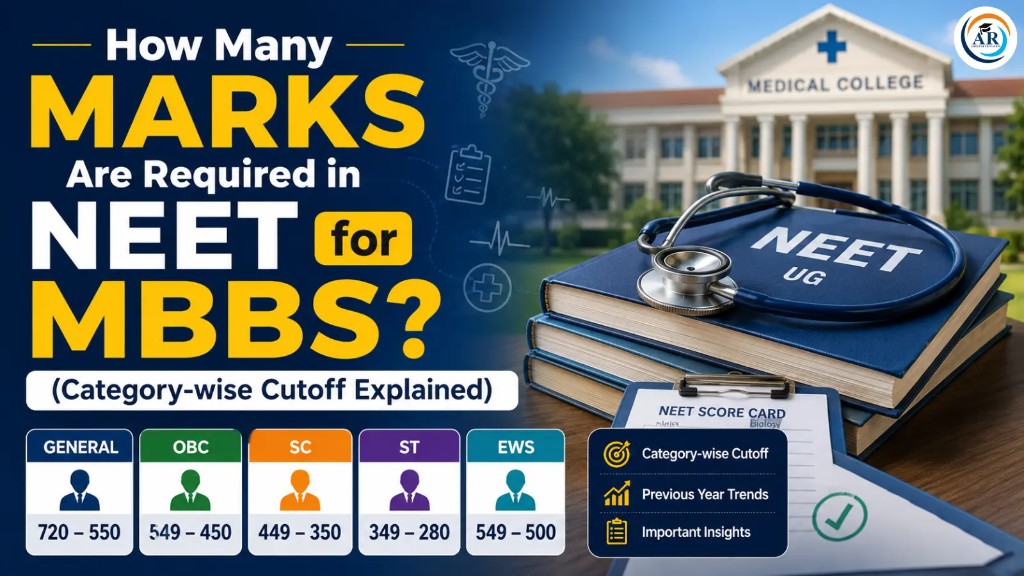
    Category Qualifying Percentile Predicted Marks Range
    General (UR) / EWS 50th Percentile 686 – 144
    OBC / SC / ST 40th Percentile 143 – 113
    General – PwD 45th Percentile 143 – 127
    OBC/SC/ST – PwD 40th Percentile 126 – 113

    How Many Marks Are Required in NEET for MBBS in Private Colleges 

    NEET MBBS admission to private colleges in 2026 typically requires a score of 350–550+ for the general category and 250–400+ for reserved categories. Government colleges require 550–600+, while private, deemed, and management quota seats have lower cutoffs. Top private colleges often require 500–600+. 

    Estimated NEET 2026 Private College Marks & Ranks

    • General Category: 350–500+ marks
    • Reserved Categories (OBC/SC/ST): 250–400+ marks
    • Management Quota/Deemed University: 200–350+ marks, though these often require much higher fees

    Key Factors for Private College Admission

    • Lower cutoffs: Private institutions often accept lower NEET scores than government institutions.
    • Counseling process: 15% All India Quota (AIQ) and 85% State Quota counseling is applicable for private colleges.
    • Fees: Higher fees are common at private and deemed universities, with annual tuition often ranging between ₹12–25 lakh.
    • Variation: Cutoffs vary widely depending on the state, university reputation, and specific quotas (e.g., management versus merit).

    State-wise Variation in NEET Cutoff: 

    NEET cutoffs vary by state, as admissions are based on state quota (85%) and All India Quota (15%). Each state has its own counseling authority, so the same score can result in different colleges in different states. Therefore, it’s crucial for students to understand the cutoff trends for their target state.

    High vs Low Cutoff States:

    The cutoff is quite high in some states, such as Delhi, Rajasthan, Uttar Pradesh, and Maharashtra. Competition is high here, and top ranks are in demand.

    However, comparatively lower cutoffs are seen in some states, such as the North-Eastern states (Assam, Manipur, etc.) or some southern states, where seats are relatively more or applicants are fewer.

    Factors Affecting Cutoff:

    • Number of Applicants:

    The more students appear for the exam, the more competition there will be, and the cutoff will also rise.

    • Difficulty Level of Exam:

    If the paper is tough, overall scores decrease and the cutoff drops slightly. If the paper is easy, the cutoff goes higher.

    • Seat Availability:

    The more MBBS seats there are, the lower the cutoff can be. If seats are limited, the cutoff automatically goes higher.

    NEET Marks vs. Rank Analysis :

    Not only are marks important in NEET, but the resulting All India Rank (AIR) determines which college you will be admitted to. However, a rough idea can be made based on previous trends:

    • 650+ Marks → Top Government Colleges

    Your rank in this range is usually quite high (top few thousands). There is a strong chance of getting into AIIMS-type institutes and top government medical colleges.

    • 600+ Marks → Government MBBS Likely

    A score around 600 gives you a decent rank, which may help you get a government MBBS seat (depending on state quota).

    • 500+ Marks → Semi-Government / Private Chances

    Government colleges become a little tougher in this range (especially in the General category), but semi-government or private colleges remain open.

    • 400+ Marks → Private Colleges

    With scores around 400, private colleges are often the most realistic option. Lower cutoffs in some states may offer slightly better chances.

    Important Note:

    This is only a rough estimate. Actual rank changes every year depending on paper difficulty, number of students, and overall performance. Therefore, you should always keep a safe target of 600+ if you are aiming for a government MBBS.

    Conclusion 

    In conclusion, the marks required in NEET for MBBS depend on factors like category, college type, and competition level. While the minimum qualifying marks may be low, securing a seat in a government medical college usually requires a much higher score, often 600+ for general category students. Private colleges may accept lower marks, but fees are higher. Since NEET cutoffs change every year based on exam difficulty and number of candidates, students should always aim for the highest possible score. With consistent preparation, proper strategy, and regular practice, achieving a good NEET score for MBBS admission is definitely possible.

    FAQs

    1. What is the minimum marks required in NEET for MBBS?
      The minimum qualifying marks vary each year, but generally around 137+ for general category and 107+ for reserved categories.
    2. Can I get MBBS with 400 marks in NEET?
      Yes, you may get a seat in private or some semi-government colleges, but chances in government colleges are low.
    3. What is a safe score for MBBS in government colleges?
      A score of 600+ is generally considered safe for government MBBS colleges, especially for general category students.
    4. Does NEET cutoff change every year?
      Yes, the cutoff changes yearly based on exam difficulty, number of students, and available seats.

    5. Can I get MBBS with low marks in NEET?
    It is difficult, but possible in private colleges or through management quota, though fees are higher.

  • What To Do After NEET Exam 2026: Complete Guide for Students

    What To Do After NEET Exam 2026: Complete Guide for Students

    What To Do After NEET Exam 2026

    What To Do After NEET Exam 2026: Complete Guide for Students

    After the NEET 2026 exam the first question that comes to mind is What To Do After NEET Exam 2026 ? Every year lakhs of students appear for NEET exam with dreams of securing a medical seat. 

    Firstly, students need to calculate their expected score on the basis of the official answer key so that they can have ideas of their probable rank. 

    Understanding the counseling process is equally important  MCC conducts counseling for AIQ (15%) seats, while the remaining 85% state quota seats are handled by the respective state authorities. Keeping documents ready, doing choice filling smartly, and not missing deadlines is very crucial.

    First Step: Don’t Panic — Analyze Your Performance

    Before jumping into decisions:

    • Compare your answers with the official answer key
    • Estimate your score
    • Understand your chances realistically

    This step helps you avoid emotional decisions and focus on smart planning.

    If You Score High: Top Medical Courses to Choose

    At this stage you have to understand What To Do After NEET Exam 2026? Because a right decision can only define your future. High score candidates can target top courses such as MBBS and BDS, while the students with average score can explore options like AYUSH courses (BAMS, BHMS) or veterinary (BVSc).

    MBBS (Most Preferred)

    • Duration: 5.5 years
    • Career: Doctor, specialist, surgeon

    BDS (Dental)

    • Great alternative with strong career scope

    BAMS / BHMS / BUMS

    • For students interested in Ayurveda, Homeopathy, or Unani medicine

    Participate actively in counselling rounds to secure the best college. Also, taking expert guidance can make your chances stronger so connect with AR Group of Education to get professional counselling for your MBBS admission and fill the form, so that you can get the best college selection, choice filling strategy and complete admission support.

    If You Get an Average Score: Smart Alternatives

    B.Sc. Nursing, BPT (Physiotherapy), and allied health sciences are also excellent career choices that offer strong growth in the healthcare field.

    Consider these options:

    • BSc Nursing
    • BPT (Physiotherapy)
    • BPharma
    • Biotechnology / Microbiology

    If Your Score is Low: What Are Your Options?

    If your score is lower than expected, dropping out or choosing an alternative career may also be a practical option. Ultimately, clarity and planning are the keys to success. Therefore, make the right decisions at the right time and confidently move forward with a clear plan on what to do after NEET exam 2026.

    Option 1: Drop a Year (If You’re Determined)

    • Prepare again with better strategy
    • Join coaching or structured guidance

    Option 2: Choose Non-Medical Career Paths

    • Life sciences
    • Allied health sciences
    • Research & lab-based careers

    NEET Counselling Process (Must Know)

    The counselling process begins after the NEET result, which will take you from your desired medical college. It is very important to understand this process because it decides which college and course you will get. 

    There are two types of Counselling: AIQ (All India Quota) and State Quota. 

    • Timely registration is crucial.
    • Fill in correct and strategic college choices.
    • Regularly track updates for each counseling round.
    • Even small mistakes can affect your seat chances.
    • So follow the entire counseling process carefully.

    After results:

    • Register for counselling: Visit the official website and register for counselling with your NEET roll number and details.
    • Fill college choices: Select colleges and courses as per your rank and preference, set the order wisely.
    • Seat allotment: Seats are allotted based on your rank, category and filled choices.
    • Document verification: It is mandatory to visit the allotted college or reporting centre and get the required documents verified.

    Conclusion 

    After the NEET 2026 exam, your journey is far from over. It’s actually the beginning of an important decision-making phase. Whether you score high, average, or low, there are multiple career paths waiting for you in the medical and healthcare field. The key is to stay calm, analyze your performance honestly, and choose a path that aligns with your interests and long-term goals. Avoid rushing into decisions due to pressure or confusion. Take time to explore your options, seek expert guidance if needed, and stay focused. Remember, success is not defined by one exam but by the choices you make afterward.

    FAQs

    1. What should I do immediately after the NEET exam?

    You should relax for a few days, then check the answer key, estimate your score, and start researching courses and counselling processes.

    2. Can I get a good career without clearing NEET?

    Yes, there are many options like BSc Nursing, BPharma, Biotechnology, and other allied health sciences with strong career scope.

    3. Should I take a drop year for NEET?

    You can consider a drop year if you are confident, motivated, and willing to improve your preparation strategy.

    4. When does NEET counselling start?

    Counselling usually begins after the result declaration. Keep checking official updates to avoid missing deadlines.

    5. How do I choose the right course after NEET?

    Consider your interest, career goals, strengths, and future opportunities before making a decision. Guidance from experts can also help.

  • NEET Deleted Syllabus 2026: Subject-Wise Reduced & Added Topics (Complete Guide)

    NEET Deleted Syllabus 2026: Subject-Wise Reduced & Added Topics (Complete Guide)

    NEET Deleted Syllabus 2026

    NEET Deleted Syllabus 2026: Subject-Wise Reduced & Added Topics (Complete Guide)

    If you’re preparing for NEET 2026, it’s important to understand that you may still be studying topics that are no longer part of the syllabus. Many students lose marks each year because they haven’t studied hard, but instead spend their time on the wrong things.This year the NEET 2026 syllabus is based on revised NCERT pattern, in which there’s no new addition, Rather, the topics that were covered in the last few years have been continued.

    This means you’ll need to study smart, not just work hard. In Chemistry, topics like Environmental Chemistry and Polymers have been removed, in Biology, chapters like Transport in Plants and Cockroaches are no longer part of the syllabus, and in Physics, topics like the Van de Graaff generator have also been removed. The overall number of chapters has also been reduced from around 97 to around 79, so that the focus remains on core concepts.

    If you’re still studying from the old syllabus, you’re wasting your valuable time. So follow the updated syllabus, focus on NCERT, and give direction to your preparation only then will you be able to score maximum in NEET 2026.

    Section 1: NEET 2026 Syllabus Update Overview

    The NEET 2026 syllabus has been officially finalised as per the guidelines of the National Medical Commission (NMC), and is completely based on the Physics, Chemistry and Biology curriculum of Class 11 and 12 of the National Council of Educational Research and Training (NCERT).This year the syllabus has been more streamlined, including total 79 core chapters means Unnecessary or low-weight topics have been removed. So that students can only focus on important and scoring areas. 

    Key Highlights of NEET 2026 Syllabus

    Official Authority:
    The official syllabus of NEET 2026 was released by the National Testing Agency (NTA) on January 8, 2026, which will be considered as the final reference for exam preparation.

    Focus Areas:
    The syllabus follows the rationalized pattern of NMC, in which overlapping topics have been reduced and more focus has been given on strengthening the basic concepts.

    Subject Coverage:

    • Biology (50% weightage): The main focus here is on cell biology, genetics, plant physiology, and human physiology these are high-scoring areas.
    • Physics: Important topics include Mechanics, Electrodynamics, Modern Physics and Thermodynamics, which demand conceptual clarity.
    • Chemistry:It is divided into Physical, Organic and Inorganic parts, where topics like Atomic Structure, Chemical Bonding and Thermodynamics are very important.

    Preparation Strategy:

    The best strategy is to base your exam on NCERT books, especially for Biology, as most questions come directly or indirectly from NCERT.

    Exam Structure:

    There are a total of 180 compulsory questions in the exam, so strong coverage and concept clarity of each subject is essential.

    NEET Deleted Syllabus 2026: Physics

    • Physics & Measurement: Topics like scope of physics, nature of laws, and accuracy/precision basics have been removed.
    • Kinematics: Basic concepts of differentiation/integration and some vector-related portions are deleted.
    • Laws of Motion: Lubrication and equilibrium of concurrent forces are no longer included.
    • Rotational Motion: Conservation of momentum and center of mass of a uniform rod are removed.
    • Properties of Solids/Liquids: Shear, modulus of rigidity, Poisson’s ratio, Reynolds number, Black Body Radiation, and Newton’s law of cooling are deleted.
    • Thermodynamics: Heat engines and refrigerators are excluded.
    • Current Electricity: Potentiometer and carbon resistors (color coding) are removed.
    • Magnetism: Cyclotron and Earth’s magnetic field topics are deleted.
    • Optics: Optical instruments, eye defects, and wave-front-based reflection are removed.
    • Electronic Devices: Junction transistor, transistor action, and oscillators are no longer part of the syllabus.

    Chemistry

    • Physical/Inorganic: Environmental Chemistry and Metallurgy are completely removed; parts of Solid State and States of Matter are reduced; Hydrogen chapter is also trimmed.
    • Organic: Polymers and Chemistry in Everyday Life are fully deleted; nitrogen compounds like cyanides/isocyanides are removed.
    • Practical Chemistry: Detection of functional groups is excluded.

    Biology

    • Diversity in Living World: Taxonomic tools and three-domain classification are removed.
    • Structural Organization: Cockroach morphology and anatomy are deleted.
    • Plant Physiology: Transport in Plants, Mineral Nutrition, and Photoperiodism are excluded.
    • Reproduction: Asexual reproduction and vegetative propagation are removed.
    • Human Physiology: Digestion, sense organs (eye/ear), and some disorders are excluded.
    • Ecology & Welfare: Environmental issues, plant breeding, animal husbandry, and parts of biodiversity are removed.

    NEET 2026 Added Topics

    Physics

    • Greater emphasis on Modern Physics applications, with more focus on real-world concepts and numerical-based understanding.

    Chemistry

    • Organic Chemistry concepts are strengthened, especially reaction mechanisms and concept clarity.
    • Increase in practical-based questions, testing application rather than rote learning.

    Biology

    • Higher weightage for Genetics & Biotechnology, making it a key scoring area for NEET 2026.

    Why This Matters for NEET 2026 Aspirants

    Ignoring syllabus updates may seem like a small mistake, but its impact can be huge. If you study outdated topics, you could end up wasting 100+ of your valuable study hours on chapters that are not going to appear in the exam. This not only wastes your time but also leaves less time for important and high-weightage topics. Result? Your overall preparation could suffer and your rank could drop significantly.

    And remember, NEET is a highly competitive exam where even a small strategic mistake can make a big difference. If your score is impacted, it directly impacts your chances of admission to top colleges, such as All India Institute of Medical Sciences (AIIMS) and Armed Forces Medical College (AFMC). So, prepare smart—follow the updated syllabus and focus only on relevant topics.

    Smart Strategy After Syllabus Change

    • Focus only on updated NCERT topics: Now follow only the latest NCERT syllabus; don’t waste time on old or deleted topics.
    • Prioritize high-weightage chapters: Focus more on those chapters that generate the most questions every year.
    • Practice previous year questions: Solve PYQs based on the revised syllabus to clarify the exam pattern and important areas.
    • Avoid outdated coaching material: Don’t use notes or modules that haven’t been revised to fit the updated syllabus.

    Conclusion 

    The updated NEET 2026 syllabus by the National Testing Agency brings a more focused and streamlined approach to preparation. By removing outdated topics and refining core concepts based on National Council of Educational Research and Training guidelines, students can now prioritize quality over quantity. Understanding the subject-wise deleted and added topics helps avoid unnecessary study and improves efficiency. Aspirants aiming for top medical institutes like All India Institute of Medical Sciences should align their strategy with these updates. Staying informed and adapting early will give you a strong competitive edge in NEET 2026.You can visit AR Group of Education for more updates. 

     FAQs

    Q1. Who releases the NEET 2026 syllabus?
    The syllabus is released by the National Testing Agency (NTA).

    Q2. Has the NEET 2026 syllabus changed significantly?
    Yes, several topics have been deleted, reduced, and a few have been added based on updated National Council of Educational Research and Training guidelines.

    Q3. Which subject has the most changes in NEET 2026?
    Biology and Chemistry have seen notable reductions, while Physics has minor conceptual refinements.

    Q4. Should I still study NEET Deleted Syllabus 2026?
    No, focusing on the updated syllabus is recommended to save time and improve efficiency.

    Q5. Where can I download the NEET Deleted Syllabus 2026 PDF?
    You can download it from the official website of the National Testing Agency or trusted educational platforms.

  • NEET 2026 Expected Difficulty Level: Comparison with Previous Year Papers

    NEET 2026 Expected Difficulty Level: Comparison with Previous Year Papers

    NEET 2026 Expected Difficulty Level

    NEET 2026 Expected Difficulty Level: Comparison with Previous Year Papers

    If you’re preparing for NEET 2026, one question is likely running through your mind: “Will NEET 2026 be tougher than previous years?” Millions of students take the exam every year, but only a few manage to secure top ranks. The main reason for this is the exam’s trend and difficulty level.

    Based on analysis of previous years, NEET 2026 Expected Difficulty Level is expected to be moderate-to-tough, similar to that of 2024 and 2025. There are no major changes to the syllabus, but competition has increased significantly more than 2.2 million aspirants are expected. Additionally, the focus of the exam is shifting from just following direct NCERT lines to conceptual clarity and application-based questions.

    Simply scoring marks isn’t enough; concepts must be strong. This is why scoring 650+ has become almost essential for admission to top government medical colleges. If you want a top rank, smart strategy, regular practice, and strong revision will be crucial. NEET 2026 won’t be easy, but with the right preparation, it’s definitely achievable. 

    NEET Exam Trend Overview

    The pattern of the National Eligibility cum Entrance Test has remained fairly balanced over the years, but one thing remains constant: its unpredictable nature. The overall structure of the paper is similar every year, but the difficulty level and question style will surprise students. If viewed subject-wise, Biology is generally of easy to moderate level. Most of the questions come directly from NCERT, making it a scoring section for students who have a strong grasp of NCERT line-by-line.

    The level of Chemistry is generally moderate, but tricky concepts here change the game. Conceptual clarity is very important in Organic and Physical Chemistry, otherwise even simple questions can appear confusing. In Inorganic, NCERT-based questions are more common, but even these have statement-based traps

    Physics is considered the most challenging section, ranging from moderate to difficult. This section often becomes a rank-decider because it requires a perfect balance of numerical problems, conceptual application, and time management. Students who excel in Physics significantly increase their chances of selection.

    Year-Wise Difficulty Comparison

    Year

    Physics

    Chemistry

    Biology

    Overall Difficulty

    NEET 2025 (Expected/Recent Trend)

    Moderate to Difficult

    Moderate

    Easy to Moderate

    Moderate

    NEET 2024

    Tough and calculation-heavy

    NCERT-based but conceptual

    Direct NCERT questions

    Moderate to Difficult

    NEET 2023

    Moderate

    Easy to Moderate

    Easy

    Moderate

    NEET 2022

    Difficult

    Moderate

    Easy

    Moderate to Difficult

    What Makes NEET Feel Difficult?

    The NEET paper isn’t just difficult because of the tough questions, but a few common factors make it even more challenging:

    Time Pressure:

    Solving 180 questions in just 3 hours is quite intense. The time allotted for each question is limited, so maintaining both speed and accuracy is crucial. Poor time management can lead to missing even easy questions.

    Conceptual Physics Questions:

    The Physics section challenges students the most. There are fewer direct formula-based questions and more concept- and application-based numerical questions. If concepts aren’t clear, understanding the questions can take time.

    Silly Mistakes:

    Many times, students lose marks even when they know the answers—due to calculation errors, misreading the question, or making mistakes while filling in the OMR. These small mistakes have a significant impact on the overall score.

    Lack of Revision:

    If proper revision is not done, concepts get mixed up during the exam. Especially in Biology and Inorganic Chemistry, memorizing facts is crucial, which is not possible without revision. Regular revision improves both confidence and accuracy.

    Conclusion

    NEET 2026 Expected Difficulty Level is likely to remain moderate, based on trends observed in the National Eligibility cum Entrance Test over the past few years. While Physics may continue to challenge students, Biology and Chemistry are expected to stay relatively scoring if prepared well.

    However, one thing is clear: the real competition is not the paper, but the number of serious aspirants. Even a moderate paper can become a rank-decider due to rising cut-offs and intense competition.

    FAQs

    Q1. What will be the NEET 2026 Expected Difficulty Level?

    NEET 2026 is expected to be moderate overall, with Physics slightly on the tougher side and Biology remaining scoring.

    Q2. Is NEET getting tougher every year?

    Not exactly. The difficulty level of the National Eligibility cum Entrance Test has remained fairly balanced, but competition and cut-offs are increasing, making it feel tougher.

    Q3. Which subject is the most difficult in NEET?

    Physics is generally considered the most difficult due to numerical problems and conceptual questions.

    Q4. Can I score 600+ marks in a tough paper?

    Yes. NEET is a relative exam, so even if the paper is tough, your rank depends on how others perform. With strong preparation, 600+ is achievable.

    Q5. How should I prepare if the difficulty level is unpredictable?

    Focus on:

    • NCERT (especially Biology)
    • Previous Year Questions (10–15 years)
    • Regular mock tests
    • Time management and accuracy

    Q6. Do previous year papers really help in NEET?

    Absolutely. Many questions in NEET are directly or indirectly based on previous trends, making PYQs one of the most powerful preparation tools.

    Q7. When should I start full-length mock tests?

    Ideally, start 3 to 4 months before the exam and increase frequency as the exam approaches.