cms.argroupofeducation.com

Category: Blog

  • MBBS Abroad Admission Process for Indian Students 2026: Complete Guide (Step-by-Step)

    MBBS Abroad Admission Process for Indian Students 2026: Complete Guide (Step-by-Step)

    MBBS Abroad Admission Process

    MBBS Abroad Admission Process for Indian Students 2026: Complete Guide (Step-by-Step)

    Pursuing MBBS abroad has become a highly popular option for Indian students these days. The main reason for this is the limited government medical seats and high competition in India. Every year, millions of students take NEET-UG, but seats are very limited. This is why students explore foreign options where admission is relatively easier and affordable.

    Countries like Russia, Kazakhstan, Georgia, and the Philippines are very popular among Indian students. Their universities are globally recognized, and the fees are also much lower than those at Indian private colleges. Furthermore, due to the English-medium programs, students do not face any language barriers.

    The next step is the application process, where you submit your documents—such as 10th-12th marksheets, passport, NEET scorecard, etc. The visa process begins after receiving the admission letter from the university. After visa approval, you finalize your travel planning and accommodations.

    The fee structure is also an important factor. Abroad MBBS generally costs between ₹15–40 lakh (approximately $1.5 million), which is considered quite affordable compared to Indian private colleges.

    In this complete guide, we will explain the MBBS abroad admission process 2026 step-by-step. First, eligibility is checked such as NEET qualification, required marks in PCB subjects, and minimum age criteria. You then select a suitable country and university based on budget, ranking, and recognition.

    Why Study MBBS Abroad in 2026?

    • No donation or capitation fees: Meaning there’s no need to pay extra money or under-the-table payments to get admission. Admission is based solely on merit and eligibility.
    • Affordable tuition fees: The cost of studying here is quite reasonable compared to private colleges in India. It’s manageable even for middle-class students.
    • Globally recognized universities (WHO, NMC approved): Degrees from universities recognized by the World Health Organization (WHO) and the National Medical Commission (NMC) are valid worldwide. You can practice both in India and abroad (following the rules).
    • English-medium programs: The entire course is in English, so there’s no language barrier. It’s easier for international students to understand and adapt.
    • High FMGE/Next success potential: If the university’s curriculum is strong, the chances of clearing the FMGE/Next increase. This helps in obtaining a license in India.

    Eligibility Criteria for MBBS Abroad (2026)

    For 2026, Indian students must be at least 17 years old by December 31st of the admission year to be eligible for MBBS abroad, must have passed 12th grade with 50% marks in PCB (40% for reserved categories), and must have passed the NEET-UG exam (MANDATORY). The degree must be 54+ months long, include a 12-month internship at the same institution, and be taught 100% in English.

    Key Eligibility & Regulations (2026)

    • NEET Mandatory

    If you want to become a doctor in India in the future, clearing NEET-UG is compulsory. This rule is according to the National Medical Commission (NMC). Without NEET, you will not be able to practice in India.

    • Academic Qualifications

    A minimum of 50% marks in Physics, Chemistry, and Biology (PCB) in 12th grade (40% for SC/ST/OBC) are required. This is the basic eligibility for MBBS abroad.

    • Age Limit

    Students must be at least 17 years old by December 31, 2026. Admission before that time is not valid.

    NMC/FMGL Regulations 2026

    • Course Duration

    The MBBS course must be a minimum of 54 months (approximately 4.5 years). Courses with a shorter duration than this will not be considered valid in India.

    • Internship

    It is mandatory to complete a 12-month internship at the same foreign university/hospital. A separate internship in India will not be accepted if it is not completed there.

    • Language

    The entire course must be in English medium. Mixed or local language programs are not accepted.

    • License Requirement

    The degree you are pursuing must grant you a license to practice as a doctor in that country. If you do not receive the right to practice there, this may be an issue in India (especially during FMGE/future licensing exams).

    MBBS Abroad Fees Structure (Approx 2026)

    Country

    Fees (Per Year)

    Russia

    ₹2.5 – ₹5 Lakhs

    Kazakhstan

    ₹2 – ₹4 Lakhs

    Georgia

    ₹4 – ₹7 Lakhs

    Philippines

    ₹3 – ₹6 Lakhs

    Top Countries for MBBS Abroad

    Russia

    • Affordable and experienced universities
    • Strong Indian student presence

    Kazakhstan

    • Budget-friendly option
    • Fast admission process

    Georgia

    • European standard education
    • Better infrastructure

    Philippines

    • US-based curriculum
    • High FMGE success rate

    Tips to Secure MBBS Admission in 2026

    • Apply early (May–August intake)
    • Verify NMC-approved universities
    • Avoid agents without credentials
    • Check FMGE results of universities
    • Prepare finances in advance

    Conclusion

    MBBS abroad 2026 is a smart and practical option for Indian students, especially given the limited seats and high competition in India. If you choose the right country, an NMC-approved university, and receive proper guidance, you can receive quality medical education at affordable fees.

    The most important thing is to qualify NEET and follow the National Medical Commission’s guidelines. Early planning, correct documentation, and trusted consultations can make your admission process smooth.

    FAQs

    1. Is MBBS abroad possible without NEET?

    No, qualifying NEET is compulsory for Indian students, otherwise you will not be able to practice in India.

    1. What is the total cost of MBBS abroad?

    Generally ₹15 lakh to ₹40 lakh, depending on the country and university.

    1. Is an MBBS abroad degree valid in India?

    Yes, if you study at a National Medical Commission-approved university and clear the FMGE/NexT exam.

    1. Which country is best for MBBS?

    Russia, Kazakhstan, Georgia, and the Philippines are popular options—depending on budget and preference.

    1. When does the admission process start?

    Usually, the process starts from May–June and intake is from September–October.

    1. Is MBBS abroad safe for Indian students?

    Yes, if you choose recognized universities and safe countries.

    1. Is part-time work allowed?

    Allowed in some countries, but the MBBS schedule is quite hectic.
  • Top Government Medical Colleges in India 2026 (NEET Rank-wise List, Fees, Cutoff & Admission Guide)

    Top Government Medical Colleges in India 2026 (NEET Rank-wise List, Fees, Cutoff & Admission Guide)

    Top Government Medical College MBBS admission

    Top Government Medical Colleges in India 2026 (NEET Rank-wise List, Fees, Cutoff & Admission Guide)

    Every year, lakhs of students appear for NEET UG with the dream of gaining admission to one of India’s top government medical colleges. Competition is expected to be tough, as seats are limited and applicants are numerous.

    If we talk about the best colleges, AIIMS New Delhi tops the list, known for its top NIRF ranking, world-class faculty, and advanced research facilities. This is followed by PGIMER Chandigarh, renowned for its clinical exposure and training. JIPMER Puducherry is also a top choice in South India, offering quality education and modern infrastructure.

    The biggest advantage of these government colleges is their affordable fees some institutions charge as little as ₹5,000 per year. The admission process is primarily through NEET UG, followed by seat allotment through All India Quote and State Counseling.

    Choosing the right college in 2026 is crucial. Students should consider their NEET rank, cutoff trends, college reputation, location, and facilities before making their decision. With proper planning and research, you can fulfill your MBBS dream from a top government college. 

    Top Government Medical Colleges in India 2026

    College Name

    Location

    Approx. Fees

    NEET Rank (Expected)

    Key Highlights

    All India Institute of Medical Sciences Delhi

    New Delhi

    ~₹6,000/year

    Top 50

    Best faculty, top research, world-class infrastructure

    Post Graduate Institute of Medical Education and Research Chandigarh

    Chandigarh

    Very low

    PG-focused

    Advanced research, strong postgraduate programs

    Christian Medical College Vellore

    Vellore

    Moderate

    High cutoff

    Excellent clinical exposure, reputed faculty

    Banaras Hindu University Institute of Medical Sciences

    Varanasi

    Affordable

    < 1000

    Strong academics, central university advantage

    King George’s Medical University

    Lucknow

    Affordable

    < 1000

    Top reputation in North India, large patient inflow

    Madras Medical College

    Chennai

    Low

    Competitive

    One of the oldest, excellent hospital exposure

    Grant Medical College Mumbai

    Mumbai

    Low

    Competitive

    Attached to JJ Hospital, strong clinical training

    Maulana Azad Medical College

    New Delhi

    Very low

    Top 100–500

    High ROI, top Delhi choice

    Seth GS Medical College

    Mumbai

    Low

    Highly competitive

    Attached to KEM Hospital, top-tier training

    BJ Medical College Pune

    Pune

    Low

    Competitive

    Good infrastructure, popular in Maharashtra

    Fees Comparison (Government Colleges)

    College Type

    Annual Fees

    AIIMS

    ₹5K–10K

    Central Universities

    ₹10K–50K

    State Govt Colleges

    ₹20K–1L

    NEET UG 2026 Counselling Process (All India Quota – AIQ)

    The admission process of NEET UG conducted by the Medical Counselling Committee (MCC) through official website mcc.nic.in,

    Step-by-Step NEET UG Counselling Process (AIQ)

    Stage

    What You Need to Do

    Key Tips

    Clear NEET UG Exam

    Qualify NEET UG with minimum percentile and secure a valid AIR

    Aim for higher rank for top colleges

    MCC Registration

    Register on MCC portal using NEET Roll Number and pay registration + security fee

    Roll Number and pay registration + security fee

    Double-check details before submission

    Choice Filling & Locking

    Select and prioritize colleges/courses

    Lock choices before deadline (mandatory)

    Seat Allotment Result

    MCC releases allotment based on rank, preferences, availability

    Keep backup choices ready

    Download Allotment Letter

    Download from MCC portal and prepare for reporting

    Print multiple copies

    Document Verification

    Visit allotted college with original documents

    Carry all certificates + photocopies

    Admission Confirmation

    Pay first-year fees and confirm your seat

    Don’t delay seat may be cancelled

    Documents Required for Verification

    • NEET UG Scorecard & Admit Card
    • Class 10 & 12 Marksheet/Certificates
    • Valid Photo ID (Aadhaar/PAN/Passport)
    • Caste Certificate (if applicable)
    • Passport-size photographs
    • Provisional Allotment Letter 

    Important Notes

    • AIQ covers 15% seats in government medical colleges across India
    • Remaining 85% seats are filled through State Counselling
    • Missing deadlines = automatic disqualification for that round

    Conclusion

    Getting into a top government medical college in India in 2026 is highly competitive but absolutely achievable with the right preparation and strategy. Your performance in NEET UG plays the most crucial role, but smart counselling decisions, understanding cutoffs, and choosing the right colleges can make a huge difference in your final selection.Government medical colleges not only offer world-class education at very low fees, but also provide excellent clinical exposure and career opportunities.

     Frequently Asked Questions (FAQs)

    1. What is the best government medical college in India in 2026?

    The top position is consistently held by All India Institute of Medical Sciences Delhi due to its excellent faculty, infrastructure, and research facilities.

    2. What NEET rank is required for top government colleges?

    For top institutes like AIIMS Delhi, you typically need a rank under 50. For other leading colleges, a rank within 500–2000 is generally required.

    3. How many government MBBS seats are available in India?

    India has over 55,000+ government MBBS seats, but the exact number may increase slightly in 2026 due to new colleges and seat expansion.

    4. What is the fee for government medical colleges?

    Fees are very affordable, ranging from ₹5,000 to ₹1 lakh per year depending on the college.

    5. Is admission only through NEET UG?

    Yes, admission to all government MBBS colleges in India is done through NEET UG only.

    6. What is the role of counselling in MBBS admission?

    After qualifying NEET, you must participate in counselling conducted by the Medical Counselling Committee (for All India Quota) and respective state authorities.

    7. Can I get a government medical college with 500 marks?

    It depends on your category, state quota, and cutoff trends. In some states, 500 marks may be enough for lower-ranked government colleges.

    8. Which is better: AIQ or State Quota?

    Both have advantages.

    • AIQ (15%) gives access to top colleges across India
    • State quota (85%) may have lower cutoffs depending on your domicile

    9. Are government medical colleges better than private?

    Yes, in most cases. Government colleges offer:

    • Lower fees
    • Better patient exposure
    • Strong reputation

    10. How can I predict which college I will get?

    You can use a college predictor tool or get expert counselling based on your:

    • NEET rank
    • Category
    • State domicile

  • MBBS Fees in Private Colleges in India 2026 – Low Fees Options Available | Apply Now

    MBBS Fees in Private Colleges in India 2026 – Low Fees Options Available | Apply Now

    MBBS Fees in Private Colleges

    MBBS Fees in Private Colleges in India 2026 – Low Fees Options Available | Apply Now

    Pursuing MBBS in India is considered a biggest achievement, especially when it comes to private colleges. Generally, MBBS fees in private colleges in India range from  ₹60 lakh to ₹1.5 crore even more. If we talk about yearly tuition fees, then it usually costs ₹10 lakh to ₹25 lakh per year and also depends on college and state. 

    Deemed universities have a very high structure. Annual fees at these institutions often exceed ₹20 lakh or more, and the total cost can easily exceed ₹1 crore. Universities charge fees based on their facilities, infrastructure, and brand value.

    On the other hand, there are some private medical colleges that offer relatively affordable options. In Karnataka, West Bengal, and some other states, fees start from ₹6 lakh to ₹9 lakh per annum, especially for state quota or merit-based seats. However, fees for management quota or NRI quota seats are significantly higher.

    Students should consider not only tuition fees, but also hostel charges, miscellaneous fees, and examination fees when considering MBBS admission. Overall, pursuing MBBS in private colleges can be costly, but with proper research and planning, students can choose the best option according to their budget.

    MBBS Fees in Private Colleges (2026 Overview)

    If you’re planning to pursue MBBS from a private college in 2026, it’s crucial to understand the fee structure. Generally, annual tuition fees at private medical colleges range from ₹10 lakh to ₹20 lakh+. These fees can be even higher at top-tier private colleges or deemed universities.

    Taking into account the total course cost, the full MBBS (5.5 years) typically costs ₹60 lakh to ₹1 crore+. This includes tuition, hostel, mess, and other charges.

    Location-wise fees also vary:

    • Uttar Pradesh: ₹11 lakh to ₹12.5 lakh per year, totaling ₹60–₹90 lakh
    • Delhi/NCR: ₹15 lakh to ₹30 lakh per year for management quota seats
    • Low-cost exception: Some reputable colleges, such as CMC Vellore, have fees as low as ₹1 lakh per year.

    In addition, students should also keep in mind additional charges. Hostel, mess, and “development fees” can add up to an additional ₹3 lakh to ₹5 lakh+ per year.

    Management and NRI quota seats have a significantly higher fee structure, where a donation may be required along with tuition. These fees are significantly higher than state counseling seats.

    Important points (for 2026):

    Verify the full fee structure before seeking admission, as hidden charges significantly increase the total cost.

    If you leave the seat midway, you may incur a heavy penalty, sometimes even paying the entire 5.5 years’ worth of fees.

    Therefore, proper research and financial planning are crucial before seeking MBBS admission.

    State-Wise Affordable Options (MBBS Fees in Private Colleges in India)

    Affordable private MBBS options in India (2026) are mostly found in states like Karnataka (₹9–12 lakh/year), Kerala (approximately ₹7–9 lakh/year), and Uttar Pradesh (₹11–14 lakh/year), which offer significantly lower tuition fees than others. Odisha offers lower fees, but it is a “closed state” for residents.

    Key States with Lower Private MBBS Fees (2026):

    • Kerala: Private MBBS fees in Kerala are quite reasonable, roughly ₹7–9 lakh per year. It is considered one of the most affordable private options in India, with strong education quality.
    • Karnataka: Karnataka is known for its good clinical exposure and stable fee structure. Fees here generally range around ₹10.5–11.5 lakh per year, which is a balanced option for both cost and quality.
    • Uttar Pradesh (UP):UP is a popular “open state” where students from other states can also apply. Fees here range between ₹11–14 lakh per year, and the admission process is considered relatively transparent.
    • Madhya Pradesh & Bihar:Private MBBS fees in these states also range from ₹10–13 lakh per year. These states offer budget-friendly options, especially for students who wish to study in North India.
    • Odisha: Fees in Odisha start quite low, around ₹6.5 lakh per year. However, it is a generally closed state, meaning admission is mostly restricted to state-domiciled students.

    Hidden Costs You Must Know (MBBS Fees in Private Colleges in India)

    When applying for MBBS admission, just looking at tuition fees isn’t enough. There are many hidden or additional costs that significantly increase the total expense. Therefore, it’s important to understand these things beforehand.

    • Hostel Charges: If you opt for a college hostel, this incurs separate expenses. Generally, hostel and mess charges can range from ₹1.5 lakh to ₹3 lakh per year, depending on facilities and location.
    • Security Deposit: A refundable security deposit is taken at the time of admission. It can range from ₹50,000 to ₹2 lakh. This amount is refunded after completion of the course (as per terms and conditions).
    • Miscellaneous Charges: This category includes lab fees, library charges, uniforms, ID cards, and development fees. Together, these can add up to an additional ₹50,000 to ₹1.5 lakh per year.
    • Exam Fees: Exam fees are also required each year or semester. The amount varies by college or university, but generally ranges from ₹20,000 to ₹50,000 per year.

    Who Should Apply (MBBS Fees in Private Colleges in India)

    Private medical colleges can be a practical option for students who want to pursue MBBS but cannot secure a government seat. This option is especially useful for those who want to choose the best possible college based on their budget and score.

    • NEET-Qualified Students

    The first requirement is to qualify for the NEET. Nowadays, NEET is mandatory for MBBS admission, whether you choose a government or private college.

    • Students with Average NEET Scores

    If your NEET score is slightly lower than the cutoffs of top government colleges, private colleges offer a good alternative. Here, you may find merit-based or state quota seats where competition is relatively manageable.

    • Families Looking for Budget-Friendly MBBS Options

    Private MBBS is expensive, but not every college has the same fees. Some states and colleges offer relatively affordable options. This option is suitable for families who want to explore budget-friendly private MBBS with smart planning.

    How We Help You 

    AR Group of Education is a trusted and reputed educational consultancy that has been providing guidance to students since 2005. With our vast experience and strong network, we have established a trusted name in India’s education sector. We have successfully guided thousands of students to reach their dream medical colleges.

    The MBBS admission process can be complex, but we make this journey simple and transparent. We provide personalized counseling, college selection, and complete admission support so that every student can make the best decision based on their budget and NEET score.

    FAQs 

    Q1. What is the total cost of MBBS in private colleges?
    The total cost of MBBS in private colleges generally ranges from ₹60 lakh to ₹1 crore+, depending on the college and state.

    Q2. Is it possible to study MBBS without donation?
    Yes, it is possible through NEET-based merit admissions, especially under state quota seats where no donation is required.

    Q3. Which states offer more affordable private MBBS options?
    States like Karnataka, Kerala, Tamil Nadu, and Uttar Pradesh are known for relatively affordable private MBBS fees.

    Q4. Are hostel and other charges included in tuition fees?
    No, hostel, mess, and miscellaneous charges are separate and can add around ₹2–₹5 lakh per year.

    Q5. What is a management quota?
    Management quota seats are offered by private colleges with higher tuition fees, and sometimes additional donation may be required.

    Q6. Is NEET qualification mandatory for private MBBS?
    Yes, qualifying NEET is mandatory for MBBS admission in both government and private colleges in India.

    Q7. Is there any penalty for leaving the course midway?
    Yes, many colleges impose a heavy penalty if you leave the course mid-way, sometimes equal to the full course fee.

    Q8. Can I get an education loan for private MBBS?
    Yes, many banks offer education loans for MBBS, subject to eligibility criteria.

  • MBBS Admission 2026 Without Donation – Apply Now | Limited Seats

    MBBS Admission 2026 Without Donation – Apply Now | Limited Seats

    View image

    The demand for MBBS is increasing every year. The reason is simple, the population is increasing and the healthcare sector is rapidly growing. Every student wants to become a doctor because this profession provides respect, stability and good income. 

    But the problem is that MBBS seats are limited and competition is very high. Every year lakhs of students appear for NEET, but seats are comparatively less. Due to this reason students and parents often get confused and pressured. 

    Worried about ₹50 lakh donation?

    Many people believe that donation is compulsory for admission to MBBS but this is not completely true.

    Reality is:

    • There is zero donation in Government colleges only merit matters
    • Even in Private colleges donation is not needed many seats are available through counselling & merit quota.
    • Due to lack of proper guidance, students fall prey to agents or fake promises.

    Truth: If you have proper strategy, correct information and right counselling support then you can easily secure MBBS admission without donation. 

    You Get MBBS Admission Without Donation?

    Yes it is absolutely possible. In today’s time to get MBBS admission without donation is completely possible because of NEET-UG all systems are merit-based and transparent. 

    Whether it is government or private college, admission is mostly based on NEET score and counselling process. 

    Simple rule:
    NEET qualify karo + counselling attend karo = No donation admission

    Ways to Secure Donation-Free MBBS Admission

    Government Medical Colleges

    • Most affordable option
    • Admission is based purely on NEET merit
    • Fees are very low
    • Donation is absolutely not required

    High NEET scores provide direct admission without donation.

    Private Colleges and Deemed Universities

    • Fees are higher, but the system is regulated.
    • Many reputable colleges offer admissions through merit and counseling.
    • All-India counseling and opportunities are available in open states.

    Important: High fees do not mean donations.

    These are official tuition fees, not illegal payments.

    Centralized Counseling

    • MCC (Medical Counseling Committee) and state authorities conduct the process.
    • Covers 15% of All India Quota and 85% of State Quota seats.
    • The process is transparent.

    By filling out the proper choice, you can get admission without any donation.

    NRI / Management Quota

    • Fees are higher.
    • But seats are legally allotted through counseling.
    • Opportunities also exist during mop-up and stray vacancy rounds.

    If the process is through official counseling, it is not a donation.

    MBBS Abroad

    • Countries like the Philippines, Russia, and Kazakhstan offer no donations.
    • English-medium education is available.
    • Budget-friendly options are also available.

    This option is useful for students with moderate NEET scores.

    Entrance Exams for MBBS 2026

    There is only one main entrance exam for MBBS admission in India NEET-UG.

    Whether you are targeting a government college or a private one, qualifying NEET is mandatory.

    NEET-UG Importance

    NEET (National Eligibility cum Entrance Test) is the single gateway to MBBS admission.

    • All medical colleges in India (government and private) accept NEET scores.
    • Without NEET, MBBS admission is not possible.
    • Admission is completely merit-based (based on rank).
    • The counseling process is also based on NEET rank.

    Simple understanding:

    No NEET = No MBBS admission in India.

    Therefore, NEET preparation is the most important step if you want to become a doctor.

    Expected Timeline for MBBS 2026

    The approximate timeline of NEET and admission process is something like this:

    • Application Form Release: December 2025 – January 2026
    • Admit Card: April 2026
    • NEET Exam Date: 3 May 2026
    • Result Declaration: June 2026
    • Counselling Start (MCC + State): July – August 2026
    • Admission & College Joining: August – October 2026

    Eligibility Criteria for MBBS 2026

    There are some basic eligibility criteria that every student must fulfill to obtain MBBS admission.

    Age Limit

    • Minimum age: 17 years (as on 31 December 2026)
    • Upper age limit: Currently no strict upper limit (as per latest updates, but subject to change)

    Simple: If youre 17+ then youre eligible for NEET

    Subjects Required (PCB)

    For MBBS you must have 12th background PCB (Physics, Chemistry, Biology)

    • Physics
    • Chemistry
    • Biology / Biotechnology
    • English (mandatory subject)

    If you have not taken PCB, you are not eligible for MBBS

    Minimum Marks Required

    Minimum marks in 12th vary according to the category:

    • General category: 50% in PCB
    • OBC / SC / ST: 40% in PCB
    • PWD (General): 45% in PCB

    Top Ways to Get MBBS Without Donation

    Getting an MBBS seat without paying a donation is completely possible if you follow the right path. Here are the top options you should consider:

    Government Medical Colleges

    Government colleges are the best option for students looking for low-cost and donation-free MBBS admission.

    • Admission is strictly based on NEET rank and merit
    • Fees are very low compared to private institutions
    • No donation or capitation fee is involved
    • Competition is high due to limited seats

    Students with a strong NEET score

    Deemed Universities (Merit Quota)

    Deemed universities also offer MBBS seats through merit-based counselling, especially under All India Quota.

    • Admission is done through centralized counselling (MCC)
    • No donation is required for merit quota seats
    • Tuition fees are higher than government colleges but are official and transparent
    • Wide range of college options across India

    Best for: Students with moderate NEET scores who can afford higher tuition fees

    MBBS Abroad (Russia, Kazakhstan, etc.)

    Studying MBBS abroad is another popular option for students seeking affordable education without donation.

    • Countries like Russia, Kazakhstan, Philippines offer recognized medical programs
    • No donation or capitation fee required
    • Many universities provide English-medium courses
    • Lower competition compared to India

    Students who want budget-friendly options with easier admission chances

    Conclusion

    MBBS admission without donation is completely possible in today’s system. With NEET-UG as the single entrance exam and centralized counselling processes, admissions have become more transparent and merit-based.

    Students who focus on achieving a good NEET score, participate in proper counselling, and explore all available options such as government colleges, deemed universities, and MBBS abroad can secure a seat without paying any donation.

    Frequently Asked Questions (FAQs)

    1. Can I get MBBS admission without donation in India?
      Yes, you can get MBBS admission without donation through NEET-based merit and centralized counselling in both government and many private colleges.
    2. Is NEET compulsory for MBBS in 2026?
      Yes, NEET-UG is mandatory for MBBS admission in India as well as for studying MBBS abroad (for Indian students).
    3. Do private colleges always require donations?
      No, many private colleges offer admission through merit-based counselling. While fees may be higher, they are official and not considered donations.
    4. What is the minimum NEET score required for MBBS?
      There is no fixed score. It depends on the category, college type, and competition level each year. Higher scores increase your chances of getting a government seat.
    5. What is the difference between fees and donation?
      Fees are official charges set by the college or authority, while donation (capitation fee) is an unofficial and often illegal payment.
    6. Can I get MBBS with a low NEET score without donation?
      Yes, you can explore options like private colleges through counselling or MBBS abroad, where admission is still possible without donation.
    7.  Is MBBS abroad a good option?

    Yes, if you choose a recognized university and follow guidelines, MBBS abroad can be a cost-effective and donation-free alternative.

  • Difference Between BAMS, MBBS, and BHMS: A Complete Guide for Medical Aspirants

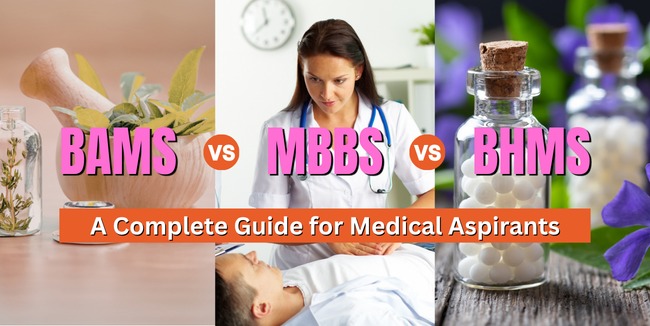
    Difference Between BAMS, MBBS, and BHMS: A Complete Guide for Medical Aspirants

    BAMS MBBS and BHMS

    Difference Between BAMS, MBBS, and BHMS: A Complete Guide for Medical Aspirants

    Many students in India dream of pursuing a career in medicine. However, when faced with options like MBBS, BAMS, and BHMS, it’s perfectly normal to feel confused. Each course has its own approach, treatment style, and career scope, so making the right decision is crucial.

    First, let’s talk about MBBS. It is based on modern and evidence-based medical science. In it, you learn the diagnosis, treatment, and surgery of diseases scientifically. If you want to pursue hospital-based practice, specialization, and high-tech medical fields, MBBS is considered the best option.

    BAMS (Bachelor of Ayurvedic Medicine and Surgery), on the other hand, is based on Ayurveda, a traditional Indian healing system. It focuses on herbal medicines, natural therapies, and body-mind balance. This course is perfect for students interested in natural healing and a holistic lifestyle.

    Now talking about BHMS, it follows the Homeopathy system. It uses the principle of “like cures like,” where treatment is done with highly diluted medicines. This approach is gentle and is considered very effective in chronic diseases.

    The duration of three courses is 5.5 years, and the NEET exam is mandatory for all. The final decision depends on your interest, career goals, and treatment philosophy. So, instead of making hasty decisions, choose your path only after understanding every option.

    Overview of Each Course

    This is a comprehensive 2026 comparison of the three major courses: MBBS, BAMS, and BHMS. Their treatment approaches, career options, and practical differences are clearly explained. MBBS focuses on modern medicine, BAMS focuses on Ayurveda and natural healing, while BHMS follows the gentler treatment system of homeopathy. This breakdown helps students choose the right medical career path based on their preferences and future goals.

    Feature

    MBBS (Allopathy)

    BAMS (Ayurveda)

    BHMS  (Homeopathy)

    Focus

    Modern Medicine & Surgery

    Traditional Indian Medicine

    “Like Cures Like” Principle

    Duration

    5.5 Years (Inc. 1yr Internship)

    5.5 Years (Inc. 1yr Internship)

    5.5 Years (Inc. 1yr Internship)

    Entrance

    NEET-UG (High Cutoff)

    NEET-UG (Moderate Cutoff)

    NEET-UG (Lower Cutoff)

    Approach

    Symptom-based Scientific Treatment

    Holistic/Root Cause

    Individualized Natural Remedy

    Authority

    Independent Surgery & Medicine

    Specialized Ayur-surgery/Panchakarma

    Acute/Chronic Management

    Avg Starting Salary

    ₹6–8+ LPA (approx.)

    ₹3–6 LPA (approx.)

    ₹2.5–5 LPA (approx.)

    Key Differences (Comparison Table)

    Feature

    BAMS

    MBBS

    BHMS

    System of Medicine

    Ayurveda

    Allopathy

    Homeopathy

    Treatment Style

    Herbal & natural

    Modern medicine

    Diluted remedies

    Popularity

    Moderate

    Very High

    Moderate

    Career Scope

    Clinics, wellness centers

    Hospitals, surgery

    Private practice

    Difficulty Level

    Moderate

    High

    Moderate

    Eligibility Criteria 

    • NEET Qualification (Mandatory in India)

    Clearing the NEET (National Eligibility cum Entrance Test) is compulsory for admission to medical courses like MBBS, BAMS, and BHMS in India. You not only need to qualify the exam but also score well, as the cut-off changes every year depending on the competition.

    • 10+2 with PCB (Physics, Chemistry, Biology)

    Students must pass their 12th class with a PCB stream, preferably from a recognized board (CBSE, ICSE, or state board). Biology is the most important subject here, as it forms the foundation for further medical studies.

    • Minimum Marks Requirement

    General categories typically require a minimum of 50% aggregate marks in PCB, while SC/ST/OBC categories require around 40–45%. The exact percentage may vary depending on the college and category.

    Salary Comparison 

    • MBBS: MBBS graduates generally enjoy a higher starting salary, especially if they get a job in a government hospital or a reputed private hospital. After an internship, one can start at ₹40,000–₹80,000 per month, and the income increases significantly after specialization (MD/MS).
    • BAMS: BAMS doctors have a moderate salary. Starting salary can be ₹25,000–₹50,000 per month, but earnings can gradually increase with experience and setting up your own clinic, especially with the growing demand for Ayurveda.
    • BHMS: Income in BHMS depends heavily on your practice and patient base. Starting salary can be around ₹20,000–₹40,000, but earnings can increase significantly once a successful private practice is established.

    Which One Should You Choose?

    • Based on Interest: First, understand your interests. If you enjoy modern science, surgeries, and hospital-based treatment, MBBS would be best. If you believe in natural healing, herbs, and a holistic lifestyle, BAMS is a strong option. However, if you prefer gentle and alternative treatment methods, you can choose BHMS.
    • Career Goals: Think about what you want to become in the future—a specialist doctor, a researcher, or running your own clinic. MBBS offers more options for specialization and hospital careers, while BAMS and BHMS offer strong scope for private practice and alternative medicine.
    • Budget and Competition Level: MBBS seats are limited, and competition is quite high. Fees are also higher in private colleges. BAMS and BHMS are comparatively affordable and there is less competition.

    Conclusion

    Choosing between BAMS, MBBS, and BHMS depends largely on your personal interest, career goals, and approach to healthcare. MBBS is ideal for students who want to pursue modern medicine with advanced clinical exposure and higher earning potential. On the other hand, BAMS and BHMS are excellent options for those interested in traditional and holistic healing systems like Ayurveda and Homeopathy. Check AR Group of Education for more. 

    (FAQs)

    1. Is NEET required for BAMS, MBBS, and BHMS?

    Yes, NEET is mandatory in India for admission into all three courses BAMS, MBBS, and BHMS.

    2. Which course has the highest salary?

    MBBS generally offers the highest salary, especially after specialization. However, BAMS and BHMS practitioners can also earn well with experience and a successful private practice.

    3. Which is better: BAMS or MBBS?

    MBBS is better if you want to practice modern allopathic medicine. BAMS is a good choice if you are interested in Ayurveda and natural healing methods.

    4. Can BAMS or BHMS doctors become surgeons?

    No, only MBBS graduates who complete further specialization (MS/MD) can become surgeons.

    5. What is the duration of these courses?

    All three courses BAMS, MBBS, and BHMS have a duration of 5.5 years, including a mandatory internship.

    6. Is BHMS a good career option?

    Yes, BHMS can be a good career, especially if you are interested in homeopathy and willing to build your own practice.

    7. Can I switch from BAMS or BHMS to MBBS?

    No, you cannot directly switch. You would need to reappear for NEET and secure admission to MBBS separately.

  • Deemed University MBBS Admission Process 2026 – Complete Guide

    Deemed University MBBS Admission Process 2026 – Complete Guide

    deemed university MBBS admission

    Deemed University MBBS Admission Process 2026 – Complete Guide

    The MBBS admission process for deemed universities is centralized and conducted completely through NEET UG 2026. This means that students can not get admission into any deemed university without qualifying the NEET. The sole basis for admission is the NEET score, and students are allotted colleges based on their rank.

    The process is managed by the Medical Counselling Committee (MCC), which fills 100% of seats in deemed universities at the all-India level. Counseling is conducted entirely online, requiring candidates to register on the official MCC website.

    The main process starts through registration, where students can apply for counselling by filling their details. This is followed by the choice filling where students select their preferred deemed universities and colleges in priority order. MCC then allotted seats in multiple rounds based on NEET rank, category, and availability of seats.

    After allotting the seat, then students have to report in their allotted college for document verification and fees payment. This step is very important, Otherwise your seat may also be cancelled.

    Overall, deemed university’s MBBS admission is a transparent and merit-based process where NEET score and MCC counselling plays an important role. Students can secure their desired college with proper planning, correct choice filling, and timely reporting. 

    NEET 2026 Eligibility Criteria

    The eligibility is quite straightforward for NEET 2026. Candidates must be at least 17 years old by December 31, 2026. And after there’s no upper age limit. Candidates must have passed 12th or appear in 2026 with Physics, Chemistry, Biology/Biotechnology and English. Minimum marks in PCB are required as per category 50% for General, 40% for SC/ST/OBC, and 45% for PwD.

    Key Eligibility Criteria for NEET UG 2026:

    • Minimum Age: Candidate’s age should be 17 years complete by 31 December 2026.
    • Maximum Age: There is no upper age limit, as per Supreme Court/NMC guidelines.
    • Birth Date Requirement: Candidate must be born on or before 31 December 2009.

    Academic Qualification (10+2 / Qualifying Exam):

    • Mandatory Subjects: Physics, Chemistry, Biology/Biotechnology and English must be core subjects.
    • Qualifying Status: Candidate must have passed 12th or appearing for board exam in 2026.
    • NIOS/Private Candidates: NIOS or private candidates are also eligible, there was some confusion earlier but now it is allowed.

    Minimum Marks/Percentile (PCB):

    • General/UR: Minimum 50% aggregate in Physics, Chemistry, Biology (PCB).
    • OBC/SC/ST: Minimum 40% aggregate in PCB.
    • PwD/General-EWS: Minimum 45% aggregate in PCB.
    • Attempts: There is no limit on the number of attempts.
    • Citizenship: Indian Nationals, NRIs, OCIs, PIOs and Foreign Nationals are all eligible for NEET 2026.

    Step-by-Step Admission Process

    This is the general, step-by-step, 5-stage admission process for MBBS/BDS courses in Deemed Universities through NEET UG 2026 based on previous trends and available information for the 2026 academic session.

    Step 1: NEET UG 2026 Qualification

    Appear & Qualify: Candidates must appear for the NEET UG 2026 exam (expected May 3, 2026) and achieve the minimum qualifying percentile.

    Result: The result is usually declared in June 2026.

    Step 2: MCC Registration

    • Portal: Register on the official Medical Counseling Committee (MCC) website.
    • Process: Log in with your NEET roll number, create a password, and fill in your personal details.
    • Fees: Pay a non-refundable registration fee + a refundable security deposit (approximately ₹2,00,000 for deemed universities).

    Step 3: Choice Filling & Locking

    • Selection: Log in to the MCC portal and select your preferred universities and courses (MBBS/BDS) in priority order.
    • Locking: Locking your choices before the deadline is mandatory.
    • Auto-Locking: If you don’t manually lock them, the system automatically locks your last saved choices.

    Step 4: Seat Allotment

    • Allotment: MCC allots seats in different rounds (Round 1, Round 2, Mop-Up, Stray Vacancy) based on NEET rank, choices and seat availability.
    • Result Format: Allotment result has been released on MCC website in PDF format.
    • Letter: After getting the seat, you have to download the provisional allotment letter.

    Step 5: Reporting to College

    • Physical Reporting: You must report to the allotted college within the given time with the allotment letter and original documents.
    • Verification: Document verification takes place at the college.
    • Fee Payment: You must confirm admission by paying tuition fees.
    • Upgradation: If you are not satisfied, you can participate in the next counseling rounds to upgrade.

    Counselling Rounds

    Medical counselling rounds (Round 1, Round 2, Mop-up aur Stray Vacancy)  are structured phases through which MBBS/BDS seats are allotted via NEET UG 2026 and counselling is conducted by the Medical Counselling Committee. These rounds follow a step-by-step process starting from  initial allotment to filling final vacant seats. 

    1. Round 1 Counseling
    • Purpose: First seat allotment based on top merit.
    • Key Feature: A free exit option is available if a candidate does not report to the allotted college, they forfeit their seat but can participate in the next round without penalty.
    • Eligibility: All eligible candidates can participate.
    1. Round 2 Counseling
    • Purpose: To upgrade Round 1 seats or allot new candidates.
    • Key Feature: Usually, there is no free exit. If a seat is allotted, joining is mandatory. If you accept a new seat, your Round 1 seat is automatically cancelled.
    • Eligibility: Candidates who did not receive a seat in Round 1, resigned, or applied for an upgrade.
    1. Mop-Up Round
    • Purpose: To fill the remaining vacant seats after Round 1 and Round 2.
    • Key Feature: Mostly conducted for deemed universities, central universities, and some state quota seats. In some cases, candidates who have already joined Round 2 cannot participate.
    • Eligibility: Generally, candidates who did not secure a seat in any of the previous rounds.
    1. Stray Vacancy Round
    • Purpose: To fill the remaining vacant seats after Mop-Up.
    • Key Feature: This round is usually conducted at the college/institution level (either online or offline), based on the list prepared by the counseling authority.
    • Risk: This round is highly competitive. If a seat is allotted, it is mandatory to take it, otherwise strict penalties (such as debarring) may apply.

    Documents Required

    • NEET Scorecard
    • Admit Card
    • 10th & 12th Marksheet
    • ID Proof (Aadhar/PAN)
    • Passport size photos
    • Allotment letter 

    MBBS Fees in Deemed Universities 

    MBBS fees at deemed medical colleges for the 2026–27 academic session are quite high. Annual tuition fees for management quota seats generally range from ₹15 lakh to ₹30 lakh+ per year. The admission process is conducted through NEET UG 2026, and counseling is handled by the Medical Counseling Committee.

    Fee Structure Overview:

    • Total Course Package:

    The full 4.5-year MBBS tuition cost can range from approximately ₹70 lakh to ₹1.6 crore.

    • High-End Fees:

    Some premium colleges charge ₹25–30 lakh per year (e.g., DY Patil Medical College, Amrita Institute of Medical Sciences).

    • Mid-Range Fees:

    Many colleges range from ₹15–18 lakh per year (e.g., KMC Manipal, JSS Medical College).

    • NRI Quota Seats:

    Fees for NRI/foreign quota seats are even higher approx. USD 40,000 to USD 85,000+ per year.

    • Annual Hikes:

    Many deemed universities increase fees by 5%–10% every year.

    • Additional Costs:

    Hostel, mess, development fees, and security deposit are separately charged, which add several lakhs to the total cost.

    Mode of Payment:

    • Annual/Semester-wise Payment:

    Fees are usually paid yearly or semester-wise.

    • Demand Draft (DD):

    Traditionally the most common method—a DD is made out in the name of the university/college (generally from a nationalized bank).

    • RTGS/NEFT/IMPS:

    Direct bank transfer is a safe and fast option for large amounts.

    • Online Payment Portal:

    Many universities offer online payment options on their websites—Debit Card, Credit Card, Net Banking, UPI, etc.

    NEET Counselling Key Points

    For 100% All India Quota (AIQ) counseling especially for deemed and central universities choice filling is the most important factor. Fees are usually high, and refund rules become quite strict after Round 2.

    Key Takeaways for NEET UG 2026 Counselling:

    100% All India Quota (AIQ): Counseling is conducted by the Medical Counseling Committee (MCC). It covers 15% government seats + 100% seats of deemed universities, central universities, AIIMS and JIPMER.

    Fees Structure: The fees of deemed universities are significantly higher than those of government/state colleges. Therefore, it is important to clearly understand the total cost (tuition + hostel + other charges) before seeking admission.

    Choice Filling Strategy: Only those colleges that you include in your choice list will be considered. Therefore, fill your preferences carefully keeping in mind college reputation, location, and fees. MCC generally conducts 4 rounds (Round 1, Round 2, Mop-up/3rd Round, and Stray Vacancy).

    Refund & Exit Rules:

    • Round 1: Free exit is available there is no penalty for leaving the seat.
    • Round 2 & After: If you join a seat, you cannot leave it afterward.
    • If you do not join after the seat is allotted, your security deposit is forfeited.
    • Registration: Always register for counseling on the official Medical Counseling Committee (MCC) website and keep checking for updates.

    Conclusion

    The Deemed University MBBS Admission Process 2026 is a completely centralized process conducted on the basis of NEET UG rank. Candidates have to follow the steps of registration, choice filling, and seat allotment through MCC counseling. Since the fees of deemed universities are comparatively high, students should fill their preferences carefully and attend counseling with proper planning. With the right strategy and timely decisions, students can secure admission to their desired medical college.

    FAQs 

    1. Is NEET mandatory for MBBS admission to deemed universities?

    Yes, qualifying NEET UG is compulsory. Admission without a NEET score is not possible.

    1. Who conducts counseling for deemed universities?

    Counseling is conducted centrally through the Medical Counseling Committee (MCC).

    1. Is there a state quota for deemed universities?

    No, 100% of seats in deemed universities are filled on an all-India basis; there is no state quota.

    1. How many counseling rounds are there?

    Generally, there are four rounds: Round 1, Round 2, Mop-up Round, and Stray Vacancy Round.

    1. Are fees refundable?

    There is a partial refund policy, but rules vary depending on the round and timing.

    1. Is choice filling important?

    Absolutely! The correct choice filling strategy increases your chances of getting a better college.

    1. What are the fees for deemed universities?

    Fees are quite high, generally ranging between ₹10 lakh and ₹25 lakh per year (depending on the college).

  • Best Private MBBS Colleges in Uttar Pradesh (UP) 2026 – Fees, Ranking, Admission & Cutoff

    Best Private MBBS Colleges in Uttar Pradesh (UP) 2026 – Fees, Ranking, Admission & Cutoff

    Best Private MBBS Colleges in Uttar Pradesh (UP) 2026 – Fees, Ranking, Admission & Cutoff

    Uttar Pradesh has become one of India’s largest medical education hubs. With over 85 medical colleges and approximately 13,000 MBBS seats available, both government and private sectors contribute significantly. Consequently, thousands of students apply for admission every year.

    The MBBS course duration is 5.5 years (including internship), and all colleges follow the guidelines of the National Medical Commission (NMC). The main gateway for admission is NEET 2026, a national-level entrance exam. Based on the scores in this exam, students are allotted colleges through the All India Quota and State Quota.

    The role of private colleges is very important because it provides a huge part of total MBBS seats. There are limited seats in Government colleges and competition is very high, Therefore, private institutions become a practical option for many students.

    Due to this reason choosing Best Private MBBS Colleges in Uttar Pradesh is a crucial decision. A good college can offer students a quality education, experienced faculty, modern infrastructure and strong clinical exposure. Due to the high patient flow in UP hospitals students get a good exposure to  real-life practical learning. 

    Choosing the right private MBBS college will build your future career on a strong foundation. Therefore, it’s crucial to carefully evaluate a college’s ranking, fees, hospital facilities, and internship opportunities before enrolling.

    Top Private MBBS Colleges in UP 2026 

    Top private MBBS colleges in Uttar Pradesh for 2026 include SRMS Bareilly, Sharda University (Greater Noida), and Era’s Lucknow Medical College, offering high-quality clinical training and modern infrastructure. In colleges, annual fees generally range between ₹12–17 lakhs, while total course fees in top institutions can exceed ₹1 crore. Admission is based on NEET-UG score, and counselling is conducted through DGME UP.Below are the college’s list with fees:

    College Name

    Location

    Est. Annual Tuition

    SRMS Institute of Medical Sciences

    Bareilly

    ₹16.48 Lakhs

    Era’s Lucknow Medical College

    Lucknow

    ₹16.60 Lakhs

    School of Medical Sciences, Sharda Univ.

    Greater Noida

    ₹12.69 Lakhs

    Hind Institute of Medical Sciences

    Barabanki

    ₹14.04 Lakhs

    Subharti Medical College

    Meerut

    ₹17.39 Lakhs

    Muzaffarnagar Medical College

    Muzaffarnagar

    ₹12-14 Lakhs

    Saraswati Institute of Medical Sciences

    Hapur

    ₹12-14 Lakhs

    Hind Institute of Medical Sciences

    Sitapur

    ₹11.70 Lakhs

    K.D. Medical College

    Mathura

    ₹17.63 Lakhs

    Noida International Institute of Med. Sci.

    Noida

    ₹11.92 Lakhs

    Eligibility Criteria for MBBS in UP 

    To be eligible for the MBBS in Uttar Pradesh (UP) 2026 candidates must qualify 10+2 with Physics, Chemistry, Biology/Biotechnology and English. With minimum 50% marks in PCB for (General), 40% (SC/ST/OBC)  and 45% (PwD), along with qualifying NEET UG 2026 is mandatory. Candidates must be at least 17 years of age as on 31 December 2026 (DOB on or before 31 December 2009). Registration on upneet.gov.in is also mandatory for counselling.

    Key Eligibility Criteria for MBBS in UP 2026:

      • NEET 2026 Qualification: Mandatory, with minimum required percentile for the state merit list.
    • Minimum Marks Criteria (10+2):
      • General/UR: 50% aggregate in Physics, Chemistry, Biology/Biotech.
      • OBC/SC/ST: 40% aggregate in Physics, Chemistry, Biology/Biotech.
      • PwD: 45% aggregate in Physics, Chemistry, Biology/Biotech.
    • Age Requirement: Must be 17 years old by 31st December 2026 (born on or before 31st December 2009). There is no upper age limit.

    Domicile Rules:

    • Government Seats: UP domicile is required.
    • Private/Private Minority Colleges: Open State Policy applies; candidates from other states can also apply for private medical seats.
    • Nationality: Indian citizens, NRIs, OCIs, PIOs, and foreign nationals are eligible.

    Admission Process for Private MBBS Colleges in UP

    1. Register: Register and pay fees on upneet.gov.in.
    2. Documents: Online verification of documents by DGMET.
    3. Choice Filling: Mandatory to fill preferences in every round.
    4. Seat Allotment: Based on NEET rank, reservation, and domicile.

    MBBS Fees in Private Colleges of UP

    • General Fee Range: Annual tuition fees at private MBBS colleges range from approximately ₹10–25 lakh per year, varying by college and facilities.
    • NRI Quota Fees: If you enroll under the NRI quota, the fees are significantly higher—typically ₹30–50 lakh per year or even more, depending on the college.
    • Other Charges: In addition to tuition fees, hostel fees (₹1–3 lakh/year), security deposit (refundable), exam fees, and miscellaneous charges (library, lab, etc.) are also included.

    Facilities & Infrastructure

    Private MBBS colleges in UP generally provide modern infrastructure, including smart classrooms, digital libraries, seminar halls, and advanced medical equipment.

    • Teaching Hospitals: Every medical college has an affiliated multi-specialty hospital, where students have the opportunity to understand real-time patient care and treatment processes.
    • Clinical Exposure: Due to the high patient flow in UP hospitals, students receive strong clinical exposure, which improves their practical skills and diagnostic abilities.
    • Hostel & Campus Facilities: Colleges provide separate hostels for boys and girls, mess, security, sports facilities, and a comfortable campus environment.
    • Labs and Research: Well-equipped laboratories (anatomy, pathology, microbiology, etc.) and research facilities are available, giving students hands-on learning and research opportunities.

    Private vs Government MBBS Colleges in UP

    Factor

    Private

    Government

    Fees

    High

    Low

    Cutoff

    Moderate

    High

    Infrastructure

    Good

    Varies

    How to Choose the Best Private MBBS College

    • Check NMC Approval: First, ensure the college is approved by the National Medical Commission (NMC) so that the degree is valid and recognized.
    • Look at Hospital Strength: Check the patient flow, bed capacity, and departments of the college’s attached hospital. More patients mean better clinical exposure.
    • Faculty & Infrastructure: Experienced faculty, modern labs, smart classrooms, and updated infrastructure are very important for quality education.
    • Location & Connectivity: The college should be located in a way that makes travel easy and basic facilities are available nearby.
    • Budget: Choose a college according to your budget, keeping in mind the fees structure, hostel charges, and other expenses.

    Conclusion 

    Choosing the right private MBBS college in Uttar Pradesh for 2026 is an important step toward a successful medical career. While private colleges offer easier admission compared to government institutions, students must carefully evaluate fees, infrastructure, faculty, hospital exposure, and NMC approval. With NEET 2026 as the entry route, securing a good score can help in getting a better college. Always compare options, check total costs, and stay active in counseling to make a well-informed and confident decision.

    FAQs

    1. What is the average fee for private MBBS colleges in UP in 2026?

    The average fee ranges from ₹10 lakh to ₹25 lakh per year, depending on the college. Some colleges may have higher fees under management or NRI quota.

    2. Is NEET 2026 mandatory for admission in private MBBS colleges in UP?

    Yes, NEET 2026 is compulsory for admission to all MBBS colleges in India, including private institutions.

    3. What is the expected NEET cutoff for private MBBS colleges in UP 2026?

    The expected cutoff may range between 150 to 450 marks, depending on the college, category, and quota (general/management).

    4. Can I get MBBS in a private college with low NEET marks?

    Yes, some private colleges offer admission through management quota, where the cutoff is relatively lower compared to government colleges.

    5. Are private MBBS colleges in UP approved and safe for education?

    Most reputed private colleges are approved by the National Medical Commission (NMC) and provide quality education. Always verify approval before admission.

    6. What is the duration of the MBBS course?

    The MBBS course duration is 5.5 years, including 1 year of compulsory internship.

    7. Is hostel accommodation available in private medical colleges?

    Yes, most private MBBS colleges in UP provide separate hostel facilities for boys and girls with basic amenities.

    8. How can I apply for MBBS admission in UP private colleges?

    You need to:

    • Qualify NEET 2026
    • Register for UP state counseling
    • Participate in choice filling and seat allotment

  • Top 6 Cheapest Countries for MBBS in 2026

    Top 6 Cheapest Countries for MBBS in 2026

    Top 6 Cheapest Countries for MBBS in 2026

    Studying MBBS abroad has become a popular choice for Indian students due to limited government seats and high paying fees of private medical colleges. Every year lakhs of students qualify NEET, but not everyone gets a government seat. For this reason students are choosing the abroad option  and looking for Cheapest Countries for MBBS in 2026. 

    For 2026, Some countries have emerged as the most budget-friendly and reliable options for Indian students. Including top choices such as Kyrgyzstan, Uzbekistan, Kazakhstan, Russia, Georgia, and Philippines. These options are not only affordable but medical universities are also recognized by the NMC (National Medical Commission), which is mandatory for practice in India. 

    The total tuition fees for MBBS in these countries range from approximately ₹15 lakh to ₹35 lakh, which is quite low compared to private colleges in India. Furthermore, the cost of living is reasonable, hostel, food, and daily expenses are easily manageable.

    Another advantage is that MBBS in these countries is offered in English medium, so language barriers are not an issue. The infrastructure, practical exposure, and international environment also prepare students for global standards.

    If you are looking for a budget-friendly, quality education and global exposure, these top 6 cheapest countries may be your best options.

    Key Factors to Consider

    MBBS Abroad has become a smart choice for Indian students, especially when the competition has high and expensive fees. Countries like Kyrgyzstan, Uzbekistan, Kazakhstan, Russia, Georgia, and the Philippines are providing quality education with affordable fees. Let’s understand the important factors in key details:

    • Tuition Fees: The total MBBS fee in these countries is approximately ₹15–35 lakhs. This is quite affordable compared to private medical colleges in India (₹60 lakh–₹1 crore).
    • Cost of Living: Monthly expenses (hostel + food + transport) range between ₹8,000–₹20,000. This is budget-friendly and easily manageable for students.
    • NMC Approval: Many universities in all these countries are NMC (National Medical Commission) approved. This means the degree is valid in India, and you can practice by taking the FMGE/NexT exam.
    • Medium of Instruction (English): MBBS courses are available in English medium, so Indian students don’t face any language barriers in their studies.
    • FMGE/NExT Passing Rate: Passing rates depend on the university, but good universities offer proper coaching and clinical exposure, which helps in clearing the FMGE/NExT. Students also need to maintain strong self-study.
    • Safety & Lifestyle: These countries are generally safe for international students. Hostel facilities, Indian food availability, and a student-friendly environment make the lifestyle comfortable.

    Quick Comparison Table

    Country

    Tuition Fees (Approx)

    Living Cost

    Duration

    Medium

    Russia

    ₹2.5–5 L/year

    Low

    6 years

    English

    Kazakhstan

    ₹2–4 L/year

    Low

    5–6 years

    English

    Kyrgyzstan

    ₹2–3.5 L/year

    Very Low

    5–6 years

    English

    Georgia

    ₹4–6 L/year

    Moderate

    6 years

    English

    Philippines

    ₹3–5 L/year

    Low

    5.5 years

    English

    Uzbekistan

    ₹2–3.5 L/year

    Low

    5–6 years

    English

    Top 6 Cheapest Countries for MBBS in 2026 (Detailed Sections)

    If you’re planning MBBS abroad , then these 6 countries are Cheapest Countries for MBBS in 2026 options for Indian students. Below are the key highlights of each country given:

    Russia

    • Affordable tuition fees
    • Globally recognized universities
    • Cold climate should be considered
    • Average Cost: ₹15–30 Lakhs total

    Kazakhstan

    • Low tuition fees & living cost
    • High FMGE passing rate (comparatively better)
    • Modern infrastructure & facilities
    • Average Cost: ₹12–25 Lakhs total

    Kyrgyzstan

    • One of the cheapest options
    • Simple admission process (low documentation hassle)
    • Best choice for budget students
    • Average Cost: ₹10–20 Lakhs total

    Georgia

    • European standard education system
    • Safe & student-friendly environment
    • Slightly higher cost compared to others
    • Average Cost: ₹25–40 Lakhs total

    Philippines

    • US-based education system
    • English-speaking country (no language barrier)
    • Strong clinical exposure & practical training
    • Average Cost: ₹20–35 Lakhs total

    Uzbekistan

    • Rapidly emerging MBBS destination
    • Affordable fees structure
    • Popularity is increasing among Indian students
    • Average Cost: ₹12–22 Lakhs total

    Advantages of choosing Cheapest Countries for MBBS in 2026

    If you’re choosing MBBS abroad, then here are some major advantages which are very beneficial in the companies of Indian private colleges:

    • Lower Cost Compared to Private Colleges in India
      The total cost of MBBS abroad is between ₹10 to 40 lakhs, while the Indian private colleges fees range from ₹60 lakhs to ₹1 crore. 
    • International Exposure
      Studying abroad students get exposure to diverse cultures, healthcare systems and  global medical practices. It enhances both your personality and career.
    • Better Infrastructure
      Many foreign universities provide modern labs, advanced technology and well-equipped hospitals, which gives students better practical learning and clinical experience.
    • No Donation Required
      Private colleges in India have capitation/donation fees, but admission to universities abroad is purely merit-based there are no donations or hidden charges.

    Who Should Choose MBBS Abroad?

    MBA abroad isn’t for every student, but it can be a perfect option for some specific students. Let’s explain in simple words:

    Students with Low NEET Scores: If your NEET score isn’t high enough to secure a government seat in India, MBBS abroad is a strong alternative. The admission process is comparatively easy, and you can continue your dream of becoming a doctor.

    Budget-Conscious Families: For families who can’t afford the ₹60 lakh to ₹1 crore fees of private medical colleges in India, MBBS abroad is a cost-effective option. Here, you can complete your medical degree within a budget of ₹10 to 40 lakh.

    Students Open to Global Opportunities: If you’re open to international exposure, new cultures, and global career opportunities, MBBS abroad is best for you. This gives you a chance to explore careers in different countries in the future.

    Conclusion

    Choosing the right country for MBBS abroad in 2026 is a crucial decision that can shape your entire medical career. With rising competition and high fees in India, many students are looking for Cheapest Countries for MBBS in 2026 options like Russia, Kazakhstan, Kyrgyzstan, and others. These countries offer quality education, globally recognized degrees, and budget-friendly tuition fees.

    FAQs

    1. Which is the cheapest country for MBBS in 2026?

    Kyrgyzstan and Kazakhstan are considered among the cheapest countries, with low tuition fees and affordable living costs.

    2. Is MBBS from abroad valid in India?

    Yes, MBBS from abroad is valid in India if:

    • The university is approved by NMC
    • You qualify NEET before admission
    • You pass the FMGE/NExT exam after completing your degree

    3. What is the minimum NEET score required for MBBS abroad?

    Students must qualify NEET (meet the cutoff marks). There is no high score requirement, but qualifying is mandatory.

    4. Which country is best for Indian students for MBBS?

    Countries like Russia, Kazakhstan, and the Philippines are popular due to affordability, English-medium programs, and good education standards.

    5. What is the total cost of MBBS abroad?

    The total cost typically ranges between ₹10 lakhs to ₹40 lakhs, depending on the country, university, and lifestyle.

    6. Is IELTS required for MBBS abroad?

    Most countries do not require IELTS for Indian students, especially if the course is offered in English.

    7. Can I practice in India after MBBS abroad?

    Yes, but you must clear the FMGE (Foreign Medical Graduate Examination) or the upcoming NExT exam to practice in India.

    8. What are the main challenges of studying MBBS abroad?

    • FMGE/NExT licensing exam
    • Language barriers in local hospitals
    • Cultural and climate differences

  • MBBS Abroad vs India – Which is Better in 2026

    MBBS Abroad vs India – Which is Better in 2026

    MBBS Abroad vs India

    MBBS Abroad vs India – Which is Better in 2026

     Choosing an MBBS Abroad vs India in 2026 depends primarily on your budget and NEET score. If you have a high NEET score and secure admission to a government medical college, India is definitely the best option. Fees are quite low (₹1–5 lakh total), education quality is strong, and most importantly clinical exposure is abundant. Due to the high patient load in India, students get real-life practice much earlier. Plus, you don’t have the stress of a separate licensing exam to practice directly in India after graduation.

    But if your NEET score is low or you can’t afford a private college (where fees can range from ₹60 lakh to ₹1 crore), MBBS abroad becomes a practical option. In countries like Russia, Kazakhstan, Georgia, Philippines, etc., the total cost ranges from ₹15–50 lakh, which is much more affordable than Indian private colleges. The admission process is also relatively simple, mostly qualifying NEET is enough; a high rank is not required.

    However, there is one important factor with MBBS abroad you will have to clear FMGE/Next to return to India and practice. This requires self-discipline and proper preparation.

    What is MBBS Abroad?

    MBBS abroad means pursuing a medical degree outside India—especially in countries like Russia, Kazakhstan, Georgia, the Philippines, etc. This option is popular for students with low NEET scores or who cannot afford the high fees of private medical colleges in India.

    Compared to India, the admission process for MBBS abroad is quite simple. You don’t need to take a separate entrance exam, only qualifying the NEET is mandatory (as per Indian regulations). This is why many students choose this option.

    Key Features:

    • Duration: MBBS abroad typically lasts 5–6 years, and includes academic study and an internship.
    • Easy Admission Process: There is no additional entrance exam; NEET qualification is sufficient for admission.
    • Affordable Fees: The total cost ranges from approximately ₹15–50 lakh, which is quite low compared to Indian private colleges.
    • Globally Recognized Degree: Many universities are recognized by WHO, NMC (as per guidelines), and other international bodies, allowing you to explore careers in multiple countries.

    MBBS admission in India is highly competitive, requiring a top NEET score for limited government seats, while abroad offers a direct, non-competitive process with lower costs. Indian admissions rely on counseling (MCC/states), whereas foreign universities usually focus on class 12th science marks and require only NEET qualification, not a high rank.

    Admission Process: MBBS Abroad vs India

    Admissions in India are extremely competitive, with a strong focus on entrance exams like JEE and NEET, along with high Class 12 marks. In contrast, international admissions follow a more holistic approach, considering factors such as extracurricular activities, personal essays, and recommendation letters, often with applications beginning a year earlier. While studying in India is generally more cost-effective, pursuing education abroad provides wider and more diverse opportunities.

    MBBS in India:
    The first step to MBBS admission in India is qualifying the NEET. Simply qualifying the NEET isn’t enough a high score is also essential. The admission process is conducted through centralized counseling, such as MCC (All India Quota and Deemed University), and individual state counseling. Competition is high (2 million+ students vs limited seats), making selection difficult. There are multiple counseling rounds, due to which the entire process can take quite a long time.

    MBBS in Abroad :
    Qualifying NEET is mandatory for Abroad MBBS (if you want to practice in India in the future), Admission is mostly direct, based on your 10th and 12th PCB marks. The process is simple, and many universities offer seats on a “first-come-first-served” basis. The timeline is also fast – quick application, quick confirmation.

    Fees Structure (MBBS Abroad vs India)

    Studying abroad in countries like the US, UK, or Canada is considerably more expensive, with total tuition and living costs for master’s programs typically ranging between ₹20–80+ lakhs. In comparison, India provides a much more budget-friendly option, where tuition fees at public institutions for specialized courses are often under ₹15 lakhs. However, there are also affordable international options countries like Germany and Malaysia offer quality education at a lower cost, usually around ₹10–20 lakhs per year.

    Fees in India:

    Government Colleges: Fees are quite affordable here approximately ₹10,000 to ₹1 lakh per year. However, getting admission here can be very difficult because of the high cutoff.

    Private Colleges: Fees are quite high here around ₹10 lakh to ₹25 lakh per year. The total MBBS cost can easily range from ₹50 lakh to ₹1 crore+.

    Fees Abroad:

    MBBS fees at foreign universities range from a comparatively low ₹3 lakh to ₹8 lakh per year (average).

    Taking into account the total cost, the overall expense of MBBS abroad is significantly lower than that of private Indian colleges.

    Quality of Education (India vs. Abroad) 

    Studying abroad typically focuses on practical application, innovation, and flexible, student-centric learning, while Indian studies emphasize a strong theoretical foundation, rigorous assessment, and academic discipline. International studies offer better research facilities and global exposure, while India offers a more affordable, structured, and familiar academic environment.

    Education Quality in India:

    Top government medical colleges in India are highly reputed and offer strong clinical exposure. Hospitals have a high patient flow, giving students valuable experience handling real-life cases. This builds strong practical knowledge, which is very helpful for future practice.

    Education Quality Abroad:

    Universities abroad generally provide modern infrastructure, advanced labs, and updated technology. Classrooms and facilities are well-developed. However, clinical exposure may be limited in some countries, as patient flow is not as high as in India. Because of this, hands-on experience may be slightly less (depending on the country and university).

    Degree Recognition (India vs. Abroad)

    Indian degrees, especially from premier institutes like IITs and IIMs, are widely recognized globally in fields such as IT, engineering, and management. However, for certain international jobs or higher studies, they may require validation, such as AIU equivalency. On the other hand, foreign degrees from countries like the US, UK, and Australia provide strong global mobility and specialized learning opportunities, but they must comply with UGC guidelines to be officially recognized in India.

    Degree Recognition in India:

    If you completed your MBBS from India, your degree is directly valid in India. After completing your internship, you can directly begin medical practice or apply for a PG degree there’s no need to take any additional licensing exams (as per the current system).

    Degree Recognition Abroad:

    If you completed your MBBS from abroad, you must clear a licensing exam, such as the FMGE (Foreign Medical Graduate Examination) or, in the future, the NEXT (National Exit Test), to make your degree valid in India.

    • Clearing the FMGE/Next is mandatory to start practicing.
    • The exam’s difficulty level is quite high.
    • Only after passing can you register in India.

    Who Should Choose MBBS in India? 

    • Students with high NEET scores: If you have a strong score, your chances of getting into a government college in India are high.
    • Those targeting government colleges: Benefit from low fees and the best clinical exposure.
    • Want to practice in India: By completing an MBBS here, you can start practicing directly, without taking an extra licensing exam.

    Who Should Choose MBBS Abroad? 

    • Students with low NEET scores: For those who find it difficult to get a seat in India, abroad is a good option.
    • Cannot afford the high fees of a private college: The total cost of an MBBS abroad is often lower than that of private colleges in India.
    • Want international exposure: You get to experience a new culture, global education system and modern infrastructure.

    Conclusion 

    The decision between MBBS Abroad vs India isn’t a one-size-fits-all one. If you have a high NEET score and can get into a government college, India is the best option offering the benefits of low fees, strong clinical exposure, and direct practice.

    But if you have a low score or can’t afford the high fees of private colleges, MBBS abroad becomes a practical and smart alternative. The admission process is easy, fees are comparatively moderate, and you also get international exposure.

    FAQs

    Q1. Is MBBS abroad valid in India?

    Yes, it is valid but clearing the FMGE/Next exam is mandatory to practice in India.

    Q2. Can you pursue MBBS abroad without NEET?

    You can get admission, but if you want to practice in India in the future, qualifying NEET is a must.

    Q3. Is MBBS abroad cheaper in India or in India?

    Government colleges are the cheapest in India. But if we compare private colleges in India vs. abroad, abroad is more affordable in many cases.

    Q4. Is there a language barrier abroad?

    It may be in some countries, but many universities also offer English-medium MBBS.

    Q5. Can you get a job in India after an overseas MBBS?

    Yes, but you’ll need to clear the FMGE/Next first, only then can you practice or work in India.

    Q6. Is MBBS abroad safe?

    Yes, if you choose a recognized and NMC-approved university, it’s a safe and reliable option.

  • How to Get MBBS with a Low NEET Score in 2026 – Complete Guide

    How to Get MBBS with a Low NEET Score in 2026 – Complete Guide

    NEET  (National Eligibility cum Entrance Test) is an all-India level medical entrance exam in India, to get admission in courses like MBBS, BDS and other medical courses NEET exam is mandatory. Qualifying the NEET Exam is most important because NEET scores are the primary basis for admission to both government and private medical colleges. Millions of students take NEET each year, but due to limited seats, competition is quite tough.

    But an important point is that not all students achieve high scores, and this doesn’t mean their medical dreams are over. Many options are available for students aiming for MBBS with a low NEET score. Options like private colleges, deemed universities, and in some cases, MBBS abroad can also be considered. 

    Other than this, the counselling process and state quota system also provides opportunities to students even with low marks. With smart planning, right guidance, and timely decisions, it is possible to get the MBBS seat.

    So, if your NEET scores are low, then don’t need to panic. With proper research and strategy, you can still achieve your dream of becoming a doctor.

    What is considered a Low NEET Score?

    It is helpful to have an idea of approximate ranges to understand your NEET score.

    • 600+ marks: Chances of getting into top government medical colleges are strong.
    • 500–600 marks: You can get into good government or decent private colleges.
    • 400–500 marks: Some state-quota government colleges or private colleges are options.
    • Below 400 marks: From here, the situation becomes a little challenging, but for MBBS with a low NEET score, private colleges, deemed universities, or foreign options can be considered.
    • Below cutoff marks: If you score below the qualifying cutoff, MBBS admission in India is unlikely, but MBBS abroad may still be an option.

    Most importantly, the NEET cutoff changes every year. This depends on factors such as paper difficulty, number of candidates, and available seats. Therefore, a score considered low one year may create a different situation the next.

    For this reason, instead of focusing solely on marks, students should also pay attention to the counseling process, college options, and backup plans. With the proper strategy, even with average or low scores, you can find your way to a medical career.

    Can You Get MBBS with a Low NEET Score?

    Yes, but options are limited.

    If you’re targeting MBBS with a low NEET score, admission depends on a few key factors:

    • Category (General/OBC/SC/ST): The cutoff for reserved categories (SC/ST/OBC) is comparatively lower, so your chances may be slightly better compared to the General category.
    • State Quota vs. All India Quota: 85% of seats are filled through the state quota, where the cutoff is sometimes lower. The All India Quota (15%) is more competitive.
    • Budget: Fees are quite high in private and deemed universities. If your budget is strong, your chances of getting an MBBS seat even with a low score increase.
    • Flexibility to Study Abroad: If you do not get a seat in India, then MBBS in countries like Russia, Kazakhstan, Philippines, etc. can be an alternative option.

    How to Pursue MBBS with a Low NEET Score: Best Alternative Pathways

    While a high NEET score is usually required for government medical colleges, students with lower scores still have multiple pathways to pursue MBBS or build a successful career in the medical field.

    1. Private Medical Colleges (Management Quota)

    Many private medical colleges offer Management Quota seats with significantly lower cutoff requirements compared to government or merit-based seats.

    Entrance Criteria

    • Requires NEET qualification only
    • Approximate qualifying scores:
    • General: 137–164OBC/SC/ST: 107–127

    Cost

    • ₹15 lakh to ₹30 lakh per year
    • Fees vary depending on the college

    Best States for Low Scores

    • Uttar Pradesh: Transparent online counselling, open to non-domicile students
    • Karnataka: Large number of private seats (around 35% management quota)
    • Tamil Nadu & Maharashtra: High availability of private and deemed seats
    1. Deemed Universities

    Deemed universities are autonomous institutions that participate in centralized counselling conducted by the Medical Counselling Committee (MCC).

    Strategy

    Focus on Mop-up and Stray Vacancy rounds, where cutoffs tend to drop significantly.

    Example Institutions & Approximate Closing Scores

    • Dr. D.Y. Patil Medical College, Pune: Around 260+
    • Santosh Medical College, Ghaziabad: Around 245+
    • SRM Medical College, Chennai: Rank around 5.5–6.3 lakh
    1. MBBS Abroad

    Studying MBBS abroad is often a cost-effective option for students with low but qualifying NEET scores.

    Important Guidelines

    As per National Medical Commission (NMC):

    • Minimum 54 months course duration
    • 12-month internship mandatory
    • University must be NMC-approved

    Popular Destinations

    • Russia: Affordable fees (₹3.5–5 lakh/year), good infrastructure
    • Kazakhstan & Uzbekistan: Shorter duration (5–6 years), globally recognized degrees
    • Georgia: Safe environment, English-medium programs
    1. NRI Quota Seats

    Students with NRI status or NRI sponsorship can access seats with the lowest cutoff requirements in private and deemed universities.

    Key Benefit

    • Seats that typically require 500+ marks may be available at 150–200 marks under this quota

    Important Note

    • Requires valid NRI documentation and sponsorship proof
    • Fees are significantly higher than other quotas
    1. Allied Medical & AYUSH Courses

    If MBBS is not financially feasible, several alternative medical courses offer strong career opportunities with lower NEET requirements.

    Popular Options

    BDS (Dental)

    • 250–350 marks can secure good private or some government-aided colleges

    AYUSH Courses (BAMS/BHMS)

    • Ayurveda and Homeopathy are growing fields
    • 240–300 marks are competitive in top private colleges

    BSc Nursing & Physiotherapy (BPT)

    • High demand healthcare careers
    • Admission may be based on 12th marks or low NEET score 

    Step-by-Step Admission Process 

    Understanding the admission process is crucial to securing an MBBS seat, especially with a low NEET score. Follow these steps carefully:

    Appear for NEET 2026

    The first and most important step is to appear for the NEET 2026 exam. Qualifying NEET is mandatory for admission to any medical college in India, including private and deemed universities.

    Check Your Score and Rank

    Once the results are declared, analyze your:

    • NEET score
    • All India Rank (AIR)
    • Category rank

    This will help you understand your admission chances and plan your next steps.

    Register for Counselling

    You must apply to different counselling authorities based on your target colleges:

    MCC (All India Quota)

    • Covers 15% All India Quota seats
    • Includes deemed universities and central institutions

    State Counselling

    • Conducted by individual states
    • Covers 85% state quota seats and private colleges

    Choose Colleges Wisely

    While filling choices:

    • Prioritize colleges based on your score
    • Include a mix of safe, moderate, and ambitious options
    • Consider factors like fees, location, and clinical exposure

    Participate in Multiple Rounds

    Do not rely on just one round. Actively participate in:

    • Round 1
    • Round 2
    • Mop-up Round
    • Stray Vacancy Round

    Cutoffs often decrease in later rounds, increasing your chances of getting a seat.

    Consider Backup Options

    Always keep alternative plans ready:

    • Management quota seats
    • Deemed universities
    • MBBS abroad
    • Allied medical courses

    Tips for Getting an MBBS with Low Marks

    • Apply to Multiple Counseling Rounds
    • Have Backup Options (BDS, BAMS, BHMS)
    • Be Flexible About Location
    • Consider Moving Abroad Early
    • Seek Expert Guidance

    Common Mistakes to Avoid

    • Waiting Only for Government Colleges
    • Not Participating in All Counseling Rounds
    • Ignoring Deemed/Private Colleges
    • Falling Into the Spurs of Fake Agents

    Alternative Medical Courses

    • BDS (Dental)
    • BAMS (Ayurveda)
    • BHMS (Homeopathy)
    • BPT (Physiotherapy)

    Conclusion

    Getting admission into MBBS with a low NEET score in 2026 may seem challenging, but it is definitely not impossible. While government medical colleges have high cutoffs, there are still multiple pathways available such as private medical colleges, deemed universities, and MBBS abroad options. The key is to stay informed, explore all available opportunities, and make timely decisions during the counseling process. Visit AR Group of Education for more. 

    FAQs 

    1. What is the minimum NEET score required for MBBS in 2026?

    The minimum NEET score depends on the category, state, and type of college. For government colleges, it is usually higher (500+), while private colleges may accept lower scores (around 250–400). Cutoffs change every year.

    2. Can I get MBBS with 300 marks in NEET 2026?

    Yes, you may get admission in private medical colleges, deemed universities, or through management quota. You can also consider MBBS abroad as a strong option.

    3. Is MBBS abroad a good option for low NEET scorers?

    Yes, MBBS abroad is a popular and affordable option. Many countries offer quality education with lower fees and no donation. However, qualifying NEET is mandatory.

    4. Can I get MBBS without NEET?

    No, NEET qualification is compulsory for MBBS admission in India and even for studying MBBS abroad (for Indian students).

    5. Which countries are best for MBBS abroad in 2026?

    Popular options include Russia, Kazakhstan, Uzbekistan, Philippines, and Georgia due to their affordable fees and recognized universities.

    6. Should I drop a year or take admission with a low score?

    It depends on your situation. If you believe you can significantly improve your score, taking a drop may help. Otherwise, exploring available options in the same year is a practical choice.

    7. What are the alternatives if I don’t get MBBS?

    You can consider other medical courses like BDS, BAMS, BHMS, or BPT, which also offer good career opportunities in healthcare.